Forrest Gander has two books coming in spring 2027, and they show different sides of a poet and novelist who keeps returning to the same questions about attention, loss, and what we owe the natural world. The Weight of a Frozen Moment arrives April 6 from Milkweed, a first novel-length look at family and place from a writer best known for his poetry. Dune Lines: New and Selected Poems follows on April 27 from New Directions, gathering roughly four decades of work. Both covers are out now, and both are worth a closer look, because the art tells you something about the books before you open them.
A novel built around two sisters and a mountain
The novel starts in a small intentional community in California's Sierra Nevada. Two sisters, Maya and Mira, grow up sharing secrets and the sense that their lives run on parallel tracks. Then adolescence starts pulling Mira away, first in small ways and then for good. Maya has to become herself alone, and the book follows her through grief, a family tragedy, and a journey to Karnataka to mark the anniversary of their father's death. Along the way she builds a deeper bond with the place that shaped her.
What stands out to me is how Gander handles the setting. He has always paid close attention to the natural world, and here that attention does structural work. The Sierra Nevada isn't just a backdrop. It acts as witness and anchor, and it gives the narrative a kind of gravitational pull. The sisters find their way back to each other partly through that ground, which is a more ambitious move than it first appears. Plenty of novels use nature as mood. Few let it carry the emotional logic of the story.
Gander's prose is restrained, and that restraint is the point. The book is quietly devastating rather than loud about it. Its central idea, that people can be separate and inseparable at once, gets handled without sentimentality. That's a hard register to hit, and it's the one that will likely make this book land with readers who came to Gander through the poems.
A cover that plays with memory
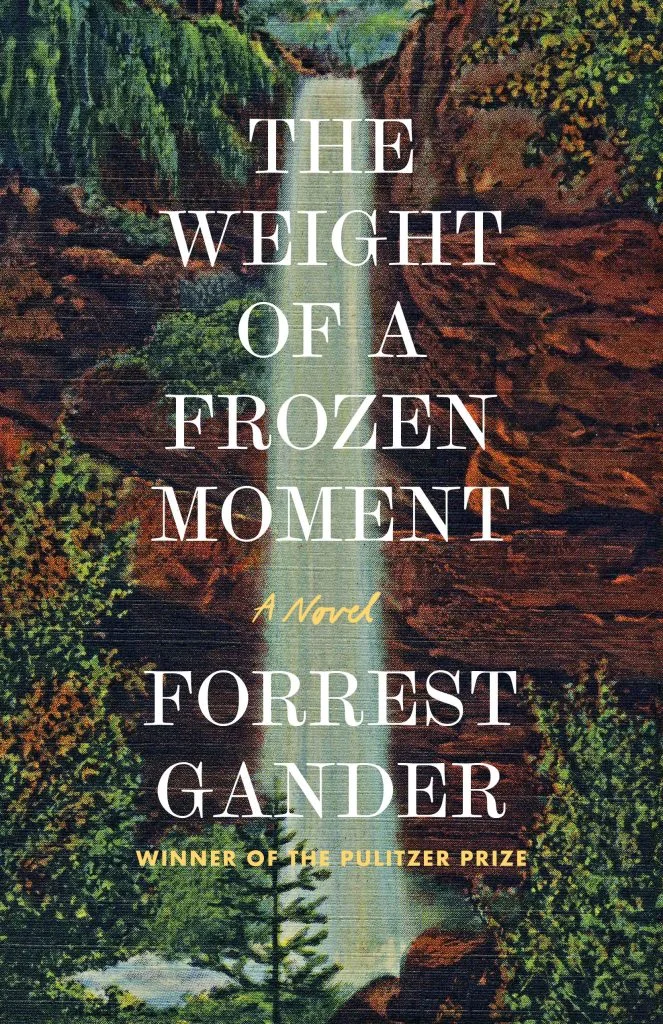
The jacket for The Weight of a Frozen Moment was designed by Mary Austin Speaker, and her reasoning reveals a lot about the book's mood. She deliberately sourced vintage artwork, which she values partly because it predates the current wave of AI-generated imagery and comes from an era when artists made images by hand. The image she chose is a 1935 lithograph of Latourelle Falls, printed by the Wesley Andrews company. Its colors are slightly askew, and the forest presses in around the edges.
Speaker's choice was a practical answer to a real problem. Waterfall imagery tends toward cliché, especially in photographs, so she went looking for something saturated and painterly. Lithographic postcards suited her because they were printed before color photography and then hand-colored, which leaves them somewhere between the real and the imagined. That in-between quality is what gives the image its unsettling pull. As Speaker put it, the cover tries to capture the feeling of finding a private place in the woods, along with the rushing-and-stillness of time and the gravity of memory that Gander builds across the book.
Gander's own reading adds another layer. He sees the image as a metaphor more than a view: part real, part imagined. The heavy, fissured rock seems to cushion the thin sheet of the waterfall, and the darkness of the forest feels more like preparation than threat. That matches Maya's position in the story. As her sister drifts into adulthood and their father grows ill, she confronts a version of herself she can't fully enter. Gander also points out that the cover doesn't gesture toward the transnational thread of the novel, but the Sierra Nevada foothills above the Yuba River Canyon and Tahoe National Forest may be the book's real main character. The cover captures that, even if it does so indirectly.
Pre-orders for The Weight of a Frozen Moment are available through Milkweed and Bookshop.org.
Forty years of poems, one shape
Dune Lines is a different kind of book. It collects work from roughly four decades of Gander's poetry, and it's meant to show the full arc of how he has built his distinctive path in contemporary poetry. The poems range widely. They ask what an ethical life looks like, what an erotic one looks like, and what it means to see yourself as made up of others, human and otherwise. The poems are worldly in scale but intimate in focus, and they fuse geological time with human time. Grief, tenderness, and a phenomenologist's curiosity about the body and the world run through the whole collection.
Gander's description of the book is useful because it points to what a selected volume has to do. It can't just reprint the greatest hits. It has to show a poet changing direction over time while keeping a consistent set of concerns. Sections from Mojave Ghost, which records a hike along the San Andreas fault into the Mojave Desert where Gander was born, sit alongside newer work. The result should read less like a retrospective and more like a single long conversation with itself.
A cover that moves
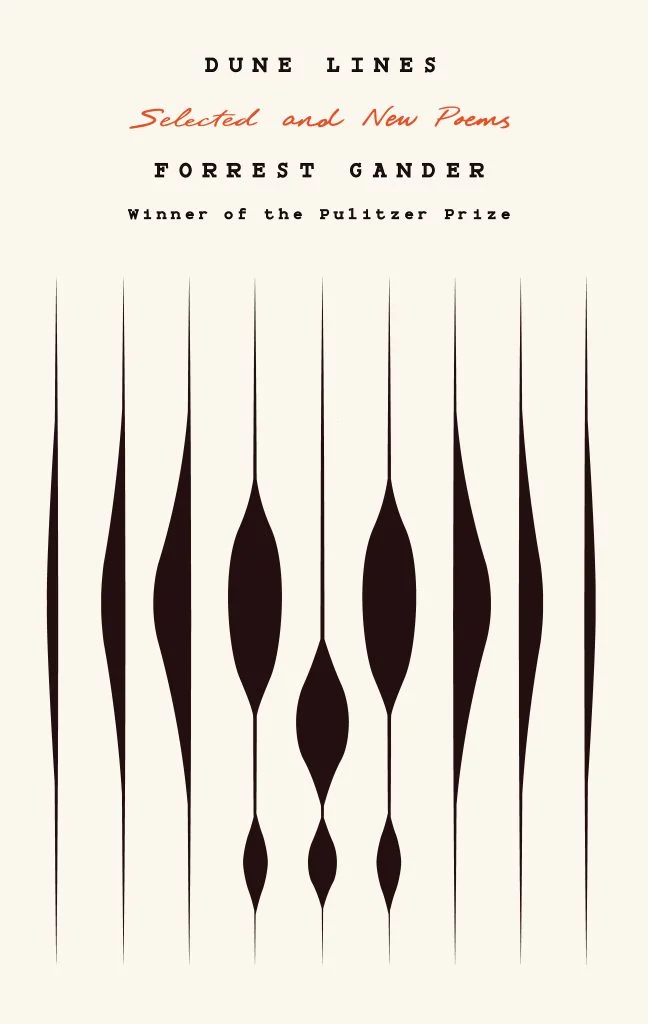
The cover for Dune Lines is Gander's third consecutive book designed by Rodrigo Corral Studios, this time a collaboration between Corral and Giacomo Girardi. It's minimal, but it isn't empty. A single vertical line repeats across the surface, swelling and narrowing until it starts to read as rhythm. Gander compares it to cymatics or oscilloscope traces, and he also finds echoes of Bridget Riley's early black-and-white Op Art and the formal discipline of Ellsworth Kelly's drawings. The shapes could be reeds, ribs, or a seismograph reading. They could also be dune lines standing upright.
That ambiguity suits a selected poems. Gander says the cover enacts the throb and ebb of the book's many sequences, where a theme or event gets approached from several angles. He even connects it to breathing, which he describes as central to his poetic process. Corral reads the same image differently. For him, the shifting line weights represent the dunes, and they meet at the center to form a skull. That's a blunt turn, and it lands with real weight. It frames the cover as a cycle: life, grief, memory, and the human place inside a geological timeline.
Two readings of one image, both persuasive, is a sign the design is doing its job. A cover for a career-spanning collection has to hold a lot at once, and this one holds rhythm, landscape history, and mortality without tipping into any one of them.
Dune Lines can be pre-ordered through New Directions. It also works as an entry point for readers who haven't followed Gander's poetry, since it puts four decades of his work in one volume.
Two books, one preoccupation
Read together, these two spring releases reveal the same concern from different angles. The novel tests whether a place can hold a family together after it has begun to come apart. The poetry collection asks how individual lives fit into deep time, and whether attention to the natural world can make that fit feel less lonely. Both books rely on Gander's habit of letting the physical world carry emotional weight. Both covers reflect that habit, one through a hand-colored lithograph and the other through a line that breathes.
The more interesting question for Gander's readers is what happens when a poet publishes a novel as his central prose statement. The sentences in The Weight of a Frozen Moment will show whether his restraint can sustain a longer narrative, and whether the poems' attention to the world can drive plot as well as image. If the answer is yes, expect more readers to treat Gander as a novelist first. Either way, April 2027 is a good month to find out.


