Ryan Harrington’s account makes a strong case that fact-checking is editorial work in its own right. At *Bon Appétit*, research review covers accuracy, cultural framing, and legal risk—and the job often comes down to knowing where to look and whom to ask.
What research review is responsible for
After a story or recipe has gone through several rounds of editing, Harrington’s team checks whether its details hold up. That means confirming names and brands, checking that restaurant menus and dishes are described accurately, assessing cited sources, and making sure quoted people are represented fairly.
The work also asks harder questions than “Is this fact correct?” Harrington says food media has long reflected a privileged point of view, sometimes treating other cuisines as discoveries and reducing cultures to curiosities. Research, in his view, should make room for people’s experiences without turning them into spectacles.
There’s a legal dimension, too. The research team connects editors with the lawyers when a story raises concerns such as libel, copyright, food safety, or the protection of sources. That range says something about the role: it’s a final editorial check, but also an early warning system.
A route into food media
Harrington didn’t begin in journalism. He earned a chemistry degree and spent six years managing operations at a thoracic surgery lab studying lung cancer. When the next step appeared to be a master’s or PhD, he reconsidered. If he was going to commit years to more study, he wanted to focus on something he cared deeply about: food media.
He enrolled in NYU’s Food Studies master’s program to examine food media’s cultural impact. An internship at *Food & Wine* led to work beyond the internship itself, and helped him see the field as a career as well as an academic subject. He later worked at *Travel & Leisure* and *Lucky Peach*. He also tried working at a brewery, starting in February 2020—an unusually difficult moment to enter the industry, but one that showed him how the pandemic affected it.
Harrington joined *Bon Appétit* as research director and has been there for five years. He credits his education and varied work experience with preparing him to lead the department.
He also teaches food studies at NYU. For both teaching and editing, he starts with the audience: Is the material clear, and what will students or readers take away? Helping people reach those moments of understanding is what he says he enjoys about the work.
Making the work a way in
Harrington’s own start came through an internship, despite having no formal journalism or media training. He says that experience gave him practical skills and professional connections, so creating a research fellowship became a priority after he joined *BA*.
The fellowship teaches research editing while giving students room to pursue their own interests. Some fellows work in the Test Kitchen and see how recipes are developed and edited; others pitch and publish stories or learn recipe styling with the photo team. Harrington wants each fellow to leave with experience that supports their individual goals.
Following the evidence, one call at a time
Harrington grew up watching Alton Brown’s *Good Eats*, and says the show fed his interest in the science behind cooking: not only how something works, but why. He particularly enjoys explanatory projects, including a video about
Dr. Arielle Johnson making a chocolate bar. Johnson and Harrington were chemistry lab partners in their first year at NYU.
Wine stories are harder. They bring specialized vocabulary, international rules, and spellings with diacritics. Harrington relies on a network of knowledgeable contacts when he needs help sorting through the details.
One assignment about San Diego bar owner Moe Girton turned into a particularly persistent search. In a 2021 story about
Moe Girton and her bar Gossip Grill, Girton described the city’s lesbian bar scene when she arrived in the late 1990s. The story’s author had asked the fact-checkers to verify three bar names. Harrington confirmed two fairly quickly; the third had little online presence.
He searched newspaper archives, community forums, and message boards. When those sources produced conflicting clues, he asked Girton for more information. She couldn’t recall many details, but she did remember the likely cross streets. Harrington called businesses in the area to ask whether they had been there in the late ’90s and remembered a nearby lesbian bar.
Eventually, the owner of
George’s Camera, a photography store operating since 1965, told him the bar next door had been Patti’s Bar, which he described as “lesbian and biker friendly.” He even had a photograph of the storefront, signs included. It’s a good example of what research can require: patient searching, a willingness to make unlikely calls, and someone’s memory backed by a picture.
Sandwiches, AI, and the limits of easy answers
Harrington’s favorite *Bon Appétit* recipe is Shilpa Uskokovic’s
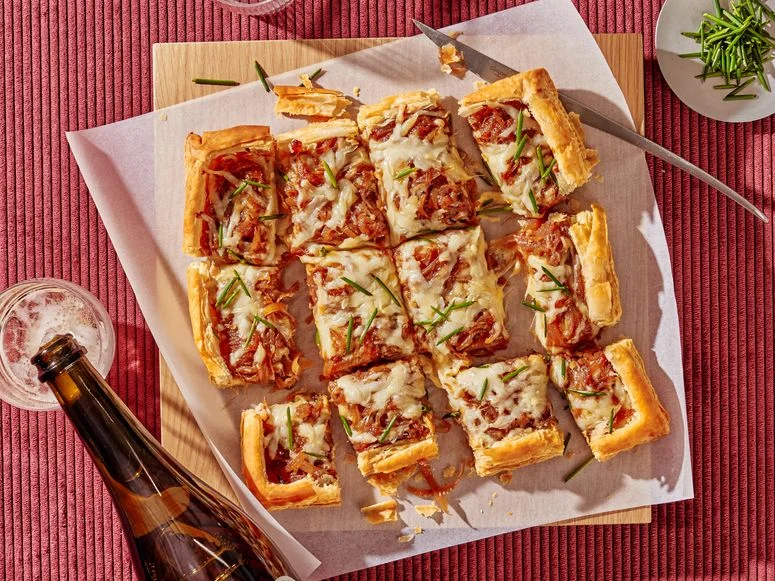
French Onion Tart. It looks like a project, he says, but takes little attention once it’s underway. The box’s two sheets of puff pastry mean one tart for guests and another for breakfast. (The recipe card also points to [puff pastry ideas](https://www.bonappetit.com/recipes/slideshow/puff-pastry-recipe-ideas).)
His preferred food trivia is a familiar argument with an unexpected legal angle: What counts as a sandwich? New York’s tax guidance says sandwiches are generally subject to sales tax, and the
NY Department of Taxation and Finance takes a broad view. A
hot dog, a
burrito, and even a buttered
bagel qualify.
Massachusetts reached a narrower conclusion in 2006. In a
Worcester Superior Court ruling, Judge Jeffrey Locke decided a burrito wasn’t a sandwich. The dispute arose after Qdoba planned to open at White City Shopping Center, where Panera had a lease clause barring competing sandwich shops. Expert testimony supported both sides; the ruling allowed Qdoba to operate there. Maybe the category has no final answer. Maybe the sandwich was the friends we made along the way.
Would Harrington do well on *Jeopardy*? He jokes that his job doesn’t require knowing everything—only knowing how to find the person who does. Ken Jennings, he suspects, won’t allow Google during filming.
That distinction also shapes his view of AI. It can summarize large amounts of information, but generated text raises real concerns when factual accuracy matters. Harrington thinks it’s too early to adopt AI across the board. Transcription is a more useful case: early in his career, he spent hours transcribing other reporters’ interviews by hand. AI transcription tools still make mistakes, so he checks the recording against the transcript, but they save substantial time.
Tools for work and downtime
In his small New York kitchen, Harrington reaches for an
immersion blender. It handles sauces, soups, salsa, and smoothies without taking up counter space or requiring him to transfer hot food between a pot and a pitcher. He also recommends
chef Frank Proto’s trick for juicing citrus with tongs, which came in handy in a sparsely equipped vacation rental.
His rewatch pick is *Happy Endings*, the ABC sitcom that ran from 2011 to 2013. Harrington describes it as a *Seinfeld*-style comedy about friends navigating young adulthood in the city, alert to the social rules that make ordinary life feel like work.
He wrote an academic paper about how the show uses—and sometimes subverts—the
big eater trope through characters of different genders and sexualities. For Harrington, those performances challenge social expectations that can feel arbitrary or limiting. Also, he says, the show is really funny.
Make Ryan’s favorite recipe
With a generous layer of caramelized onions and plenty of sharp Gruyère cheese, this party-ready tart packs the rich depth of French onion soup into every bite.
View Recipe
To support the team’s journalism and get access to its thousands of Test Kitchen–vetted recipes,
consider subscribing.