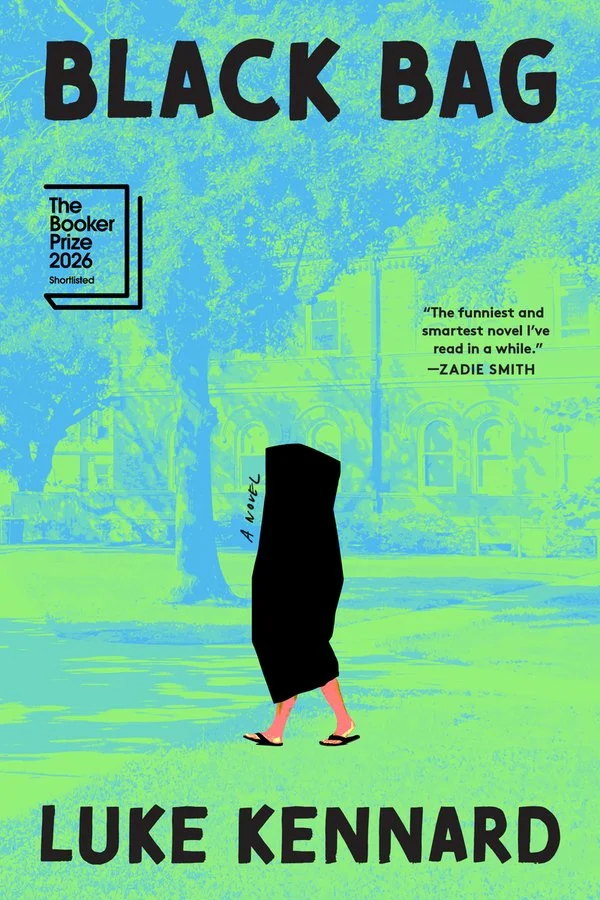
When a broke actor finds a job that requires him to sit inside a black leather bag, the strangest part isn’t the assignment. It’s how quickly the work gives him something he’s been missing: a reason to get up, a sense of purpose and enough income to make rent. Luke Kennard’s Black Bag has been marketed as a book about men in crisis. My read is that its sharper subject is the crisis of work—and the economic insecurity that gets mislabeled as a failure of masculinity.
That distinction matters. Talk of a “male loneliness epidemic” can feel badly misplaced when women continue to face violence and institutions fail to hold perpetrators accountable. In September, a former Cornell student sued the university and seven fraternity members, alleging that they drugged and raped her. No one was arrested, two students were expelled, and her lawyer said some of the others were permitted to make amends by writing an essay. Against that backdrop, treating men’s loneliness as the defining social emergency is bound to provoke anger.
Still, men’s circumstances deserve scrutiny, particularly because men hold so much economic and political power. As Kennard puts it in his Booker-shortlisted novel: “When damaged men have money and influence, that’s a problem for the whole world.” The question is what, exactly, is damaging them—and whether the popular answers address the cause.
A job inside a bag
Black Bag follows an unnamed 37-year-old London actor who hasn’t been paid for months and is falling behind on rent and bills. “I have measured out my life in coffees I cannot technically afford,” he says. His break comes through an advertisement from Dr. Blend, a university professor looking for an actor to sit silently at the back of his lectures, zipped inside a black leather bag.
The role is ridiculous and humiliating. It also gives the actor several months of what he calls “a level of fiscal security I have never experienced in adult life.” He wants to do the work well. Soon, the bag becomes more than a costume he wears in class: on days off, he puts it on to walk around London, ride the bus and visit cafés. Without it, he sees himself as “some pitiful and unremarkable man going around, doing things. Shameful.”
His fantasies reveal what the novel thinks is missing. Zipped into the bag during lectures, he imagines living in an isolated Swedish town and working at a sawmill. The dream isn’t fame or wealth. It’s a workplace where supervisors support him as he learns. The actor’s most extravagant escape is the prospect of having a decent boss.
That’s a pointed premise for a novel so often described as a portrait of modern masculinity. Kennard does write with care about isolation and the difficulty of expressing affection. The narrator reflects on his parents: “What I want to say is thank you. English people have such a deep-seated suspicion of disingenuousness that we often forego gratitude altogether.” He is lonely. But the book’s account of his growing confidence is tied to having a job, income and a place in a working routine. The bag makes work absurd; the security it offers is not.
Why the masculinity label sticks
The book’s jacket calls it “an investigation into the crisis of masculinity,” and The Sunday Times described it as a meditation on the difficulty of being a man today. One blurb presents it as comic relief from the manosphere; another points to its critique of contemporary masculinity. Those descriptions aren’t baseless, but they can obscure the material problem at the center of the story.
“The crisis of masculinity” is a compelling frame. “The crisis of rent” is less likely to attract attention. Yet focusing on gender identity can make economic hardship seem like a personal defect, or a problem that men can solve by becoming more traditionally masculine. That shift lets the people with power off the hook. It also risks directing public frustration toward women and other groups rather than toward low wages, insecure employment and shrinking worker protections.
In the United States, some prominent political prescriptions for men lean heavily on traditional gender roles. JD Vance has proposed $9,000 per child for married couples. The Heritage Foundation has urged RFK Jr. to target birth control pills, invoking concerns about estrogen in the water and male fish becoming “girly”. Josh Hawley’s book Manhood points men toward Bible study and early marriage, while condemning pornography and video games. Secretary of War Pete Hegseth has framed the project as a rejection of “wokeness and weakness,” including “no more dudes in dresses.”
The common idea is that masculinity exists in a fixed supply, and that women, Democrats, transgender people, immigrants or feminists have taken too much of it. But many of the needs men describe aren’t specific to men. People need food, health care, affordable housing and reliable child care. Some needs vary by gender, of course. Yet treating economic hardship as a problem rooted in demographic identity can hide how widely those pressures are shared.
Very few of my needs are specific to my gender.
Insecurity has an economic history
Black Bag gives the actor what those prescriptions leave out: work that pays. The broader numbers help explain why that matters. In 1983, one in four working men belonged to a union; today, the figure is one in ten. The Economic Policy Institute estimated that NAFTA had cost the United States nearly 700,000 jobs by 2010, most of them in manufacturing, an industry that is 71 percent male. Later trade policies and tariffs haven’t restored those jobs as promised.
Now, automation raises another set of questions about employment. Anthropic CEO Dario Amodei told Axios that AI could push unemployment as high as 20 percent. The source article notes that he then returned to building the technology, while the United States had not enacted federal AI regulation. The precise effects of AI remain uncertain, but workers already facing unstable careers have reason to wonder what happens when companies can automate more tasks.
Kennard’s narrator links being broke with not being a man. When he lists reasons he doesn’t consider himself masculine, one is: “I don’t have any money to speak of, am, in fact, flat broke.” That connection deserves a closer look. If joblessness becomes evidence of failed manhood, a structural economic problem gets recast as a personal crisis. The actor isn’t short on testosterone. He has no stable career path and no dependable income.
Why is joblessness related to testosterone, rather than a late-stage capitalist world order?
That’s why the book’s odd employment arrangement feels so revealing. It gives its protagonist not just money, but a degree of recognition and routine. He can imagine learning a trade under a supportive supervisor. His story suggests that dignity doesn’t depend on restoring some supposedly lost version of manhood. It can come from work that pays fairly, treats workers as people and offers a future.
That case connects naturally to unions. Their purpose isn’t to make every job fulfilling; it’s to give workers more power to protect decent wages and conditions. In a labor market where health insurance can depend on a job that might disappear, security and bargaining power aren’t side issues. They shape whether work can offer the stability the actor finds inside his bag.
Changing the question
Framing the problem as a crisis of masculinity asks individual men to change: marry earlier, pray more, have children, give up pornography or check their testosterone. Kennard’s character tries none of that. His identity crisis recedes when he gets a job, however strange it may be. The novel’s focus on paid work makes for a more useful question: what would it take for more people to have reliable income and work worth showing up for?
That question leads toward policy and power. It means discussing wages, unions and the concentration of ownership, as well as the risk that automation could displace more workers. Those topics demand more from people in charge than advice about how individuals should behave. Gender traditionalism, by comparison, offers a ready-made story about who is to blame and a familiar set of restrictions to impose.
The distinction doesn’t erase men’s isolation, or make gender irrelevant. It puts those experiences in context. A man can be lonely and economically insecure at the same time; the novel’s point is that the second problem may be driving much of the first. When a steady job lifts the actor’s sense of failure, Black Bag makes the case that many men need economic security more than a new theory of masculinity.
It’s easier to sell a story about masculinity than to confront the conditions that leave people unable to afford a home or at risk of losing their livelihoods. But Black Bag suggests that what men need is not a narrowing of other people’s freedoms. They need well-paid, protected work and a chance to feel valued. That would help everyone—and it makes Kennard’s strange, tender novel a bracing argument for taking labor seriously.
The post The Crisis of Masculinity Is Actually a Crisis of Capitalism appeared first on Electric Literature.
===