Ayad Akhtar’s new novel, The Radiance, asks readers to sit with questions about consciousness, love and the soul. That’s a more demanding project than a fast-moving plot, and Akhtar knows it. His answer is a structure that keeps changing the story’s frame—and a bet that readers will follow if each new version gives them something to reconsider.
I first saw Akhtar’s work near the end of Disgraced’s Broadway run at New York’s Lyceum Theater, before the play won the 2013 Pulitzer Prize for Drama. I went with my older sister. Afterward, two blocks from the theater, we heard what seemed to be fellow audience members arguing about the production on their way to the subway. I’d never heard a play provoke that kind of debate. Its argument had escaped the stage.
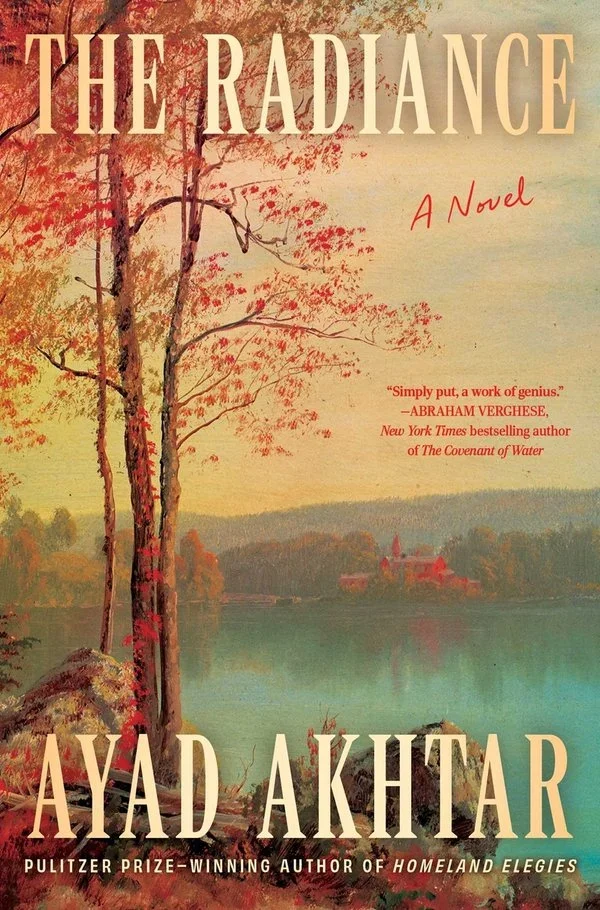
Akhtar is also a novelist, and The Radiance, his third novel, marks a shift from the tightly plotted, Aristotelian shape of his plays. Its central character, also named Ayad, nearly dies in a car crash in rural New York, where he is about to teach at a university. The accident unsettles his understanding of the world. What follows is a book that moves between revelation and apparent madness, attending closely to how consciousness takes in and reshapes power, ideology and desire.
In our conversation, we discussed the difference between writing for a theater audience and a solitary reader, the novel’s “TikTok dramaturgy,” Akhtar’s relationship with the literary canon, and the influence of his actor training on his prose.
Cherry Lou Sy: You’ve built a remarkable body of work in both plays and prose. How do you know whether an idea belongs in a play or a novel?
Ayad Akhtar: A play needs immediacy. It has to cross the distance between the stage and the audience. A novelist can, in a sense, speak quietly into a reader’s ear; a playwright can’t. Onstage, you can’t simply explain nuance or provide context. You have to put it into dialogue and action.
Some material announces itself as active from the start. It asks less of the audience before they can enter the story. Political language also tends to work well in a theater. Listening to characters argue gives people some distance from the argument; they can weigh it without feeling directly preached at or persuaded. Rhetoric has always had a theatrical force—Shakespeare shows that again and again. Action and politics both point toward stories that may be better suited to drama.
I couldn’t have made The Radiance into a play. It has scenes that could feel theatrical, but there’s so much surrounding context that I wouldn’t know how to convey it to an audience.
I’ve been feeling increasingly that readers are less patient, and that they’re less patient with the long crawl of a three-act structure.
CS: The novel’s structure feels unusual. How did you work out its shape—or its plot, if that word applies?
AA: I’ve come to think that readers have less patience for the slow unfolding of a three-act structure. They want an early sense of what the middle might offer, and they’re eager to know where the story is headed. So I thought in two movements: set up an expectation, then quickly fulfill or frustrate it and introduce another one. You could call that “TikTok dramaturgy.”
I mean that seriously. Indian classical music has a concept of gradually reaching the melody’s essential juice: the music takes time to reveal what lets that core be understood and savored. Social media storytelling tends to get to the juice quickly, with less setup. I wanted to borrow that quick disclosure while still making the story deepen. The novel returns to events in different forms—a legal filing, a campus report, Lucie’s monologue, therapy sessions. Each version adds information and changes the meaning of what came before. The question becomes not simply “What happens next?” but “What story am I reading now?” I hoped that shifting question would carry readers through the more demanding sections. The difficulty, I hope, is repaid by the experience of being absorbed in the book.
Love supplied another organizing principle. The novel is plainly about Eros, or desire, but also about Agape, love for one’s fellow person, and Storge, the love of kin. Its first section moves through Storge, the second through Agape, and the third through Eros. Each ends in a kind of crescendo. Even if readers don’t identify that design consciously, I wanted them to feel its pattern of expectation and fulfillment.
CS: The repeated versions of the story made me think of Ovid’s Metamorphoses, with its stories nested inside stories. I also saw a divide in the character between the Western canon and a colonial or postcolonial inheritance—mind on one side, spiritual body on the other. The accident forces Ayad to piece himself back together. I’ve started thinking of the two Ayads—the writer and the character—as Schrödinger’s Ayad.
AA: That’s a beautiful reading. It connects to a passage in Carl Jung’s memoir Memories, Dreams, Reflections. Jung recounts visiting a Native American reservation in the United States, perhaps in the 1930s, and speaking with an elder. Jung says the man described white people as confused when they spoke of being “here,” pointing to the head. “We’re here,” he said, pointing to the heart. “We don’t understand what it is to say that you’re in the head.”
Some traditions treat the heart’s intelligence as a place where divisions can be reconciled. I’m also thinking of Plato’s The Symposium, which runs through the novel in different ways. Aristophanes tells a story in which people were once whole circles, then cut in half, and now search for their other halves. The left-right division can work as another image of that separation and longing.
I don’t know if I have an ideal reader. I write to the part of myself that is like a kid who doesn’t want to be bored.
CS: The book makes the reader work through a lot of references. Should readers recognize them all? Who did you imagine reading it?
AA: Theater gives me time with an audience. During Broadway previews, for example, I get three weeks in the room with them. With every play, I get to see the audience I actually wrote for, and that changes how the play comes into focus. I do a lot of rewriting. A book doesn’t give me that same process.
I don’t know that I have an ideal reader. I’m writing for the part of myself that’s like a kid who doesn’t want to be bored. I want to stay engaged, while leaving the door open to anyone willing to come along. Some of the language and ideas ask more of a reader. I like that when I find it in someone else’s work. Shakespeare is the writer I spend the most time reading, and I still have to work at him. The effort pays off. I want to make something that challenges me, too. It’s all right if it challenges the reader.
CS: Shakespeare is the writer you return to most. You began with actor training, including work with Grotowski. How has acting shaped your writing?
AA: Acting taught me how much language can embody. An actor has to make complex ideas and emotions physical, and communicate them through speech with force and immediacy. The audience has to feel the contradictions, without stopping to analyze them first. That training became part of how I think about writing and art: storytelling can embody complexity. Shakespeare does that better than anyone.
CS: I watched your interview with Jeffrey Goldberg at The Atlantic about your play McNeal. You said Shakespeare stole.
AA: I said that about [King] Lear. Seventy percent of its words, I said, came from another play with a similar title and much of the same plot—a very bad play. Shakespeare had acted in it twenty years before writing his own version. That’s an interesting model for making art.
CS: It gives a literal meaning to “great artists steal.”
AA: “Lesser artists borrow, great artists steal.” People attribute that to Picasso, though Stravinsky may have said it first and Picasso may have taken it from him. T. S. Eliot said it too. Who knows where he got it?
CS: Your work seems to think about greatness and the canon. How do you put yourself in conversation with that tradition, rather than treating it as a status marker?
AA: That’s a question I haven’t been asked before. I appreciate it.
The canon has a status dimension. Canonical works can signal status, or help critics and readers reach for it. When a writer draws on that kind of cultural capital, readers may see a status play. I’m less interested in that than in duration: why do certain works remain with us for two thousand years? What patterns, themes, resonances or characters let them endure? If I use Plato’s Great Speech in Phaedrus, for instance, it has to keep speaking to me.
Continuing to think of ourselves as machines is not only going to continue to destroy our environment and destroy our world, it’s going to destroy us.
I remember reading Saul Bellow’s Ravelstein. His books had mattered to me when I was younger, but I thought he was cautious around metaphysical questions. He wanted to address them, though the literary climate of the 1960s and 1970s made that difficult. It remains difficult, though less so than it was then.
Ravelstein, Bellow’s final novel, draws on his friend Allan Bloom, a lifelong student and teacher of Plato who could speak freely and richly about metaphysics. Bellow admired Bloom. By shaping Abe Ravelstein around him, Bellow could give room to his own metaphysical interests through a character who carried Plato with him.
That taught me something. I wanted to ask about the nature of reality, while recognizing that the book can raise those questions without answering them. To do that, I needed to expand the reader’s awareness through language and association. Plato, Emerson, Dostoyevsky and many others in the novel helped me do it.
CS: In that interview with Jeffrey Goldberg, you discussed AI and the soul. As I read The Radiance, I felt the character was trying to describe what a soul is through his own experience.
AA: Exactly. That suggests the book may be doing what it set out to do.
CS: I had to work to get there. The book creates an expansive, immersive space, which may be difficult for readers accustomed to a ten-second take. Where does it fit in this moment, when AI is, as you’ve said, at a pre-Cambrian explosion?
AA: I said to Jeff that automated thinking and automated imitation of human behavior may make us increasingly aware that we aren’t machines. That could revive questions about what we are, what the soul might mean, and what people once meant when they spoke of a soul. I think we’re already seeing that shift: renewed interest in faith, and new questions about experience connected to psychedelics, among other things.
As people recognize that we aren’t machines, we may also see the cost of continuing to treat ourselves that way. It can damage the environment and the world around us, and ultimately damage us, too. We need another way to understand ourselves. I hope the novel contributes to a wider return of these questions in literary fiction. Russian writers spoke about the soul constantly. I don’t see why we can’t.
CS: Because we’re capitalists.
AA: There you have it.
The post THE RADIANCE Finds Narrative Juice in the Ancient Greeks’ Forms of Love appeared first on Electric Literature.