These five reviews make a case for very different kinds of literary ambition: Annie Proulx’s unruly abundance, Louise Kennedy’s hard-won compassion, William Gass’s punishing inwardness, Tom Drury’s quiet decency, and William T. Vollmann’s sprawling account of American power. The common thread isn’t scale or style. It’s what a novel can make visible about the lives and systems we’d rather simplify.
Annie Proulx turns excess into an art
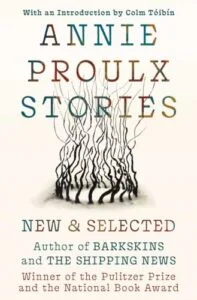
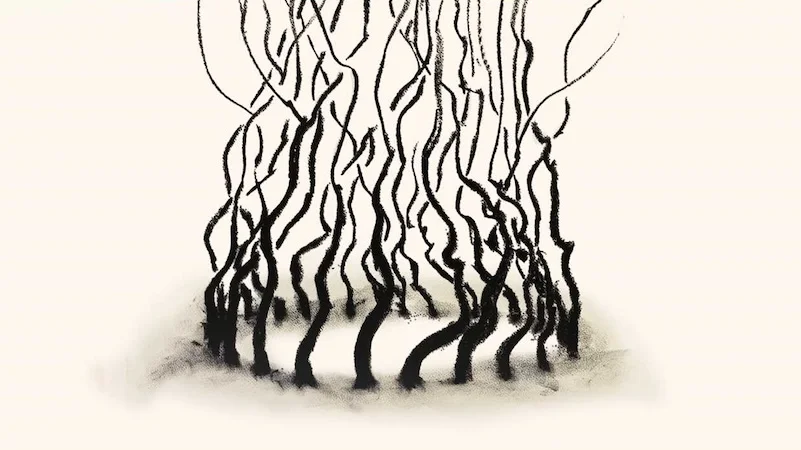
Dwight Garner’s portrait of Annie Proulx begins with a useful warning: her fiction doesn’t trim the edges. It piles detail upon detail, like a junk-filled closet whose contents come crashing down. The comparison is grotesque, deliberately so. Proulx’s new career-spanning collection, Stories: New & Selected, earns Garner’s praise precisely because its clutter feels designed, not accidental.
The stories’ violence is just as crowded. Garner lists chain-saw accidents, deaths from emu claws, babies struck by trucks, amputations, brain injuries, fatal fires, murders, and children trapped in mine shafts. The effect recalls Michael Lesy’s Wisconsin Death Trip, a record of calamity. Proulx’s characters seem to live beneath a steady weight of disaster.
Here’s the thing: Garner argues that the overload is the method. Out of chaotic prose, Proulx draws what he calls “wild, wind-chapped poetries.” Her dense language also carries a critique of modernity and its promises of smooth, protected living. In these stories, new money arrives with doctors who buy old ranches as weekend homes; nothing has been cleaned up for the reader’s comfort.
Garner reaches for James Joyce’s piled-up associations, Gustav Klimt’s layered paint, and Charles Ives’s clashing musical textures to describe Proulx’s accumulations. Stephen King once likened his own writing to a Big Mac and fries. Garner’s deliberately unappetizing counterpoint for Proulx is a platter of gizzards, chicken feet, and deviled kidneys. The comparison is pointed: her work asks you to accept the mess as part of its force.
—Dwight Garner on Annie Proulx’s Stories: New & Selected (The New York Times)
Louise Kennedy follows the damage across generations
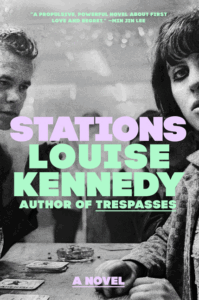
In Clare Clark’s reading, Stations is a love story that refuses to make love sound like a cure. Louise Kennedy follows a relationship across 25 years through diary-like entries, with long gaps between bursts of dated scenes. There’s a structural echo of David Nicholls’s One Day, but the London setting is harsher: squats, gas heaters, and payphones for which the characters can’t find enough change.
The people in the novel carry the fractures of the Irish diaspora: displacement, poverty, violence, addiction, shame, and loss. They leave Ireland and make new homes and families, but the past travels with them. Clark’s point is stark: distance doesn’t deliver escape from the self.
Kennedy moved to London as a young woman, and Clark praises the precision with which she evokes the city in the 1980s. Her greater strength, though, is her attention to damaged people without reducing them to their damage. Róisín is confrontational as a teenager, and also funny, filthy, generous, and painfully vulnerable. She changes with age, sometimes learning to manage herself better, but her essential nature holds. Clark suggests that this continuity is part of what makes her feel alive.
The title carries two meanings. It points to the trains, boats, and coaches that mark a migrant’s passage, and to the Catholic Stations of the Cross: the 14 images of Jesus’s final day. That combination fits a novel concerned with movement and inherited suffering, particularly the violence and fear passed from father to son. Kennedy asks whether people can break cycles of anguish and neglect, and whether imperfect love can be enough. Clark finds no easy answer in the book—and that’s part of why its questions linger.
—Clare Clark on Louise Kennedy’s Stations (The Guardian)
William Gass makes the reader live inside a mind
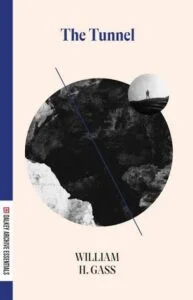
John Semly’s account of The Tunnel makes clear that William Gass’s novel is difficult in more than one sense. Decades of writing and rewriting produced an enormous book of violent, overblown prose, doodles, diagrams, bawdy limericks, and wordplay. It was also hard to obtain: long out of print, old copies could sell for hundreds of dollars. Dalkey Archive has reissued it in full color, as Gass intended, with a companion volume, The Tunnel Reader.
The republication gives readers a way back into a book that is both exasperating and rewarding. Semly sees it as a study of American authoritarianism: how exclusion and resentment grow from what Gass called “the fascism of the heart.” The novel doesn’t present that politics as a tidy historical argument. It makes the reader inhabit the sour, unstable consciousness from which it emerges.
Its narrator, Kohler, digs a tunnel beneath the floor of his basement office and hides the excavated dirt in his wife’s antique wardrobes. The act could be an effort to escape a stifling, sexless home, an attempt to flee himself, a kind of grave-digging, or simply a gesture meant to embody desperation. The book never settles the question. The literal tunnel becomes an image of the reader’s descent into Kohler’s psychology.
Semly argues that Kohler can’t be treated as a conventional unreliable narrator, because there’s no independent account of reality against which to check him. Everything takes place inside his mind; he is, in a sense, the text. Gass’s ideal of literature—linked in the review to Proust’s capacity to let readers inhabit a fully realized world—is turned toward an imperfect consciousness. Semly’s sharp shorthand: it’s as if Proust wrote The Turner Diaries.
That said, the book’s filth and absurdity aren’t decoration. Semly connects its crude cartoons, dirty jokes, fantasies, and “obnoxious effluvium” to an anti-Enlightenment tradition, invoking Theodor Adorno’s claim that writing poetry after Auschwitz was barbaric. In this reading, Gass makes ugliness part of the form: a deliberately barbarous way to approach a barbarous subject.
—John Semly on William Gass’s The Tunnel (The Nation)
Tom Drury’s quiet fiction has a civic argument
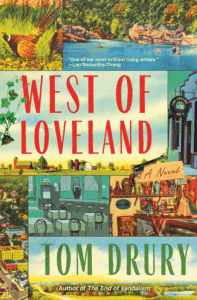
Daniel Mason finds the map at the front of Tom Drury’s West of Loveland more than a guide to the setting. Its grid links the towns of Grouse County, Drury’s fictional home territory, and marks odd landmarks such as the Swedish House, the Earring, the Gates of Hell, and the Gun. The map is part quilt, part puzzle, part network diagram—a fitting picture of a novel built from interwoven lives.
Mason connects Drury’s invented county to William Faulkner’s Yoknapatawpha County. In a 1956 interview with The Paris Review, Faulkner described discovering that his “own little postage stamp of native soil” could become “a cosmos of my own.” He later mapped that world in a collected volume. Drury’s map makes a similar claim for Grouse County.
The novel is the fourth in Drury’s series set there, though Mason says new readers can enter without having read the earlier books. Familiarity comes quickly, through small routines: conversations, modest meals, and work that includes caring for the sick, running a thrift shop, and tearing down a silo. The large cast doesn’t crowd the book because Drury’s portraits are so affectionate and particular.
“Quiet” is the word Mason returns to—not as a synonym for slight, but as a description of Drury’s unobtrusive control. Even the novel’s clever turns of phrase can take a moment to reveal their force. And its decency raises a question. Is the prevailing goodness Mason sees in Grouse County a picture of how people are, or an account of how they might be?
That question gives the book a civic edge. Mason suggests the map may be an invitation to follow a path toward tolerance and public engagement, virtues that seem as vulnerable as the county’s farms and fields. He recalls Irving Howe’s 1953 defense of “writers of sweetness,” who don’t treat evil as humanity’s final word. Drury’s novel makes a case for that gentler tradition.
—Daniel Mason on Tom Drury’s West of Loveland (The New York Times)
William T. Vollmann’s CIA epic finds tragedy in the office
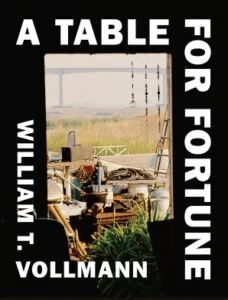
Nick Holdstock reads William T. Vollmann’s 3,000-page A Table for Fortune as a reckoning with American myths at the country’s 250th anniversary. Written over 15 years and published in four volumes at once, the novel combines a family saga with an insider’s history of the CIA. Its central concern is the cost of American exceptionalism and the pursuit of liberty, both at home and abroad.
Vollmann’s unusual choice is to make much of the agency’s history feel like workplace comedy. The CIA narrates in its own institutional voice, armed with acronyms, codenames, jargon, and a relentlessly sardonic tone. The jokes are about office resentments and sexual tension, but the narrator’s idea of “fun” includes death and suffering. That dark humor draws readers into material ranging from the Angolan civil war to Stasi interrogation methods, while exposing the agency’s double standards.
The scale is daunting, and Holdstock argues that the historical burden partly justifies it. One of DAVE’s bosses insists that truth has to be told “detail by detail.” Vollmann follows the United States’ gradual entanglement in unwinnable conflicts almost day by day, moving between domestic and political life. Holdstock compares the effect to Uwe Johnson’s epic Anniversaries, which culminates in the Soviet occupation of Prague: the slow dread of watching a crash unfold in extreme slow motion.
By the final volume, the comedy curdles. An elderly DAVE finds a basket of rolled white towels at home, kept nearby “just in case somebody wanted to bleed to death.” The image captures the book’s bleak diagnosis of a United States still unable to reconcile personal freedom with the power of the state. Vollmann presents many views of that conflict and declines to resolve it. The joke, as Holdstock’s review suggests, is that a neat answer would miss the point.
—Nick Holdstock on William T. Vollmann’s A Table for Fortune (The Guardian)