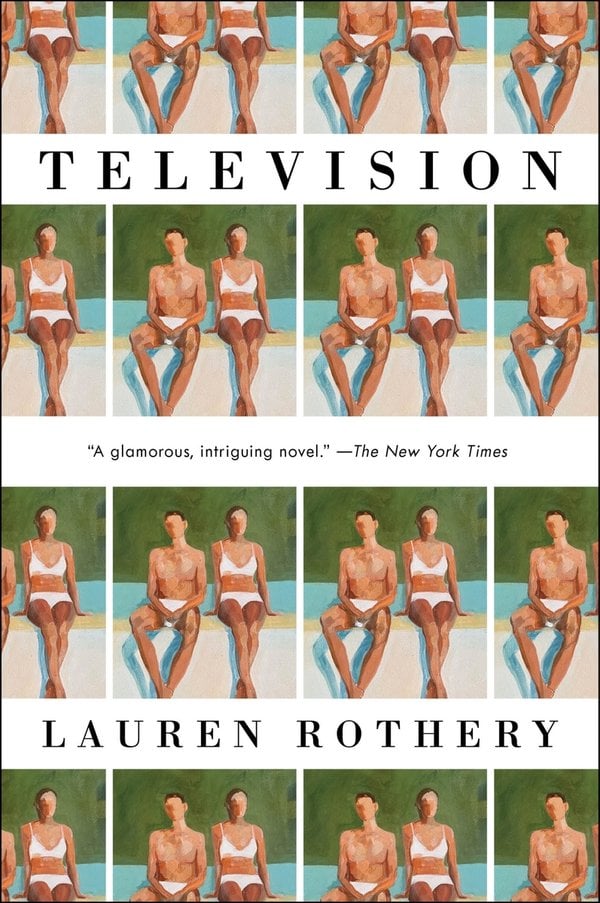
Lauren Rothery’s Television treats Hollywood success as an unstable mix of talent, appearance and chance. Its central pair, Verity and Helen, share a long, intimate friendship, but their careers diverge sharply: Verity becomes a star, while Helen struggles to find the same footing. That imbalance gives Rothery’s debut novel its central tension. The two know each other unusually well, yet celebrity changes the terms on which they can remain close.
Verity is handsome enough that he wonders whether looks, rather than ability, account for his rise. When a blockbuster brings him a multimillion-dollar salary, he tries to address that imbalance by giving the money away through a lottery. The gesture brings him still more attention, frustrating his hope that it might settle his doubts about what he deserves. Rothery makes his uncertainty more revealing than any easy verdict on whether his success is earned.
In a move that can read as tender and unsettling at once, Verity buys the apartment building where Helen lives and takes the unit beside hers. Their closeness has a domestic shape, but not the secure substance of a conventional shared life. The novel’s shifting perspectives and spare, often elliptical scenes make that gap palpable: routines can feel intimate, while the roles the characters play together keep them at a distance from themselves. For Rothery, performance is not simply a mask. It can become part of how people love and understand each other.
Rothery and interviewer Evander James Reyes spoke over Zoom about the novel’s form, the friendship at its center, and the forces that shape careers in film and the arts. Television is scheduled for paperback release on November 3.
A novel built around time spent together
The title came early, Rothery says, and connects to several strands of the book. One is the shift in the entertainment business from film toward television and streaming. Another is a more personal idea of television: the pleasure of returning to a cast of characters simply because you want to spend time with them. As Verity describes it late in the novel, the attraction isn’t necessarily the plot. It’s the company.
That sensibility shapes the book’s structure. Rather than arrange Verity and Helen’s story around a sequence of major turning points, Rothery lets the reader encounter them at different times, sometimes out of order. She was drawn to the quieter exchanges and private thoughts that show how people move through the world when they have known each other for years. Familiar ways of speaking can signal intimacy, she explains, but they can also help people avoid saying what is really happening.
“I wanted to write a relationship where the reader felt like they were in on it,” Rothery says. She describes Verity and Helen’s bond as a friendship with a persistent romantic charge. They may be together or apart, but neither seems to regard the separation as a final break. In her account, their connection rests on an assumption that neither will find anyone else they like as much.
Rothery connects that recognition to the Yiddish word landsman, which can describe meeting someone from your homeland or finding a person who sees the world as you do. That shared way of seeing helps explain why Verity and Helen remain attached even as success and circumstance push them into different lives.
I wanted to write a relationship where the reader felt like they were in on it.
When a role becomes part of a relationship
The novel’s Hollywood setting gives its interest in performance an added edge, but Rothery sees the idea as relevant to relationships generally. People often become a particular version of themselves around someone they love. That version may be incomplete, even rehearsed, without being false. Over time, a couple can repeat a shared role that feels comforting and precious; it can also create distance from the people playing it.
Rothery sees that tension as a paradox of closeness. The life two people build together can feel real precisely because they keep tending it, yet it can also seem like something separate from either person. In Television, that instability echoes the artifice of the entertainment business. Verity’s public identity, his imagined domestic life with Helen and the story he tells himself about his goodness all involve performance.
His wish to be good is tangled up with his views of beauty and success. Verity associates virtue with what he considers innocence or purity, and at times with a lack of conventional attractiveness or money. He describes his mother as ugly and angry, yet attaches to her a moral quality he does not grant his handsome, accepting father. The lottery grows from a similar confusion: Verity seems to hope that giving away his salary will correct an unfair outcome, perhaps by putting the money in the hands of someone more deserving.
When the lottery winner fails to match Verity’s idea of a worthy recipient, the result disappoints him. Rothery says he doesn’t fully understand what drives his own gesture. His wish to act honorably follows him even when he makes choices he knows others may see as questionable. That friction gives his idea of goodness less the clarity of a principle than the force of a persistent personal problem.
If you’re making art because you have to, and you’re making what you love, then you just hope for the best.
Luck complicates the meritocracy story
Rothery’s experience on the fringes of filmmaking informs the novel’s skepticism about artistic success. She spent about a decade taking on modest on-set jobs to support her own projects. From that vantage point, she became wary of the idea that good work naturally finds an audience and brings in money. In film, she says, the resources required to make a project mean that chance and access can shape which work gets seen.
She has come across brilliant films, as well as work in music and other art forms, by creators who never became widely successful. That gap makes it hard to separate choice from circumstance. Rothery calls luck deeply involved in artistic careers, a reality that can also relieve some of the pressure placed on artists: “If you’re making art because you have to, and you’re making what you love, then you just hope for the best.”
Verity embodies one side of this tension, convinced he has received more than he earned. Rothery points out that people who succeed often tell a meritocracy story because they want to believe their achievements came entirely from their own work. The novel sets his self-doubt against that more confident account of success, without resolving the question into a simple lesson about talent or deservingness.
Aging adds another measure of how unevenly Hollywood values people. Verity, approaching 50, begins to worry about losing sexual appeal. Helen has never seen herself as beautiful by the industry’s standards, while Phoebe, another character, is starting to compare her own aging with that of actresses. Rothery is interested in the message young women absorb that their best years are tied to being 25 and conventionally beautiful. She finds the effort to cling to youth especially strange because appearance will inevitably change.
Helen responds to that pressure by trying to write about aging in a way that amuses or interests her. Phoebe encounters it from a different angle, with the deaths of her grandparents feeling remote even as she begins tracking actresses’ appearances. Rothery doesn’t offer a tidy resolution. Instead, the characters’ differing concerns show how expectations about age and appearance arrive at different points in life and weigh on people in distinct ways.
Form shaped by each narrator
The book’s changes in format, including passages of screenwriting and shifts in typeface, reflect how each character processes experience. Verity often sounds as if he is speaking directly to the reader, in an extended flow of thought. Helen’s voice feels more like a letter. Phoebe, who is preoccupied with writing and the limits of different forms, sometimes turns to script when she can’t make sense of what she’s experiencing in prose.
For Rothery, that shift lets readers watch Phoebe work an experience into a form she didn’t have before. The act of writing can clarify something for the character and, in turn, help the reader understand her. It also draws on Rothery’s filmmaking background. Fiction, she says, offers freedom from the practical costs of production: “With fiction, if I want something to be a certain way, it can just be that way.”
Her experience on film sets still shapes how she edits. Rothery says she cuts heavily and had already spent years finishing work independently before the novel sold, which helped keep its later editing process short. The book’s shifting forms and compressed scenes reflect that attention to what each voice needs to say. Its characters stay compelling partly because the novel leaves room for what they can’t quite explain about themselves.
Rothery’s novel links Hollywood’s public theater to the private habits people form with one another. Verity can’t settle whether his fame reflects ability, appearance or luck, and his attempt to answer that question only puts him further in view. Helen and Verity, meanwhile, keep returning to a bond that feels both lived and performed. The book’s clearest insight may be that neither art nor intimacy comes with a clean line between what is earned, what is chosen and what simply happens.


