This article contains spoilers for Alien vs. X-Men #2.
A familiar horror with a mutant twist
The Xenomorphs in Marvel’s Alien vs. X-Men have inherited a terrifying advantage: mutant powers. That twist changes the basic arithmetic of the franchise’s host-based reproduction. Each creature already threatens the people around it; now, the traits passed on from a host can make the next generation harder to fight. The possibility that the aliens could acquire Multiple Man’s ability to create duplicates raises the stakes from a dangerous infestation to a potential crisis of scale.
The five-issue miniseries, co-written by Chris Claremont and Kieron Gillen with art by Geraldo Borges, sends Cyclops, Beast, Kitty Pryde, Emma Frost and Wolverine into space to search for a Phoenix Egg. Instead, they find a ship full of Xenomorph eggs. When the vessel crashes outside Xavier’s School, the other X-Men are dead, while Wolverine is kept alive as a recurring host. That setup gives the comic a direct way to put the familiar mechanics of Alien against a team whose powers are usually their best defense.
 Marvel Comics
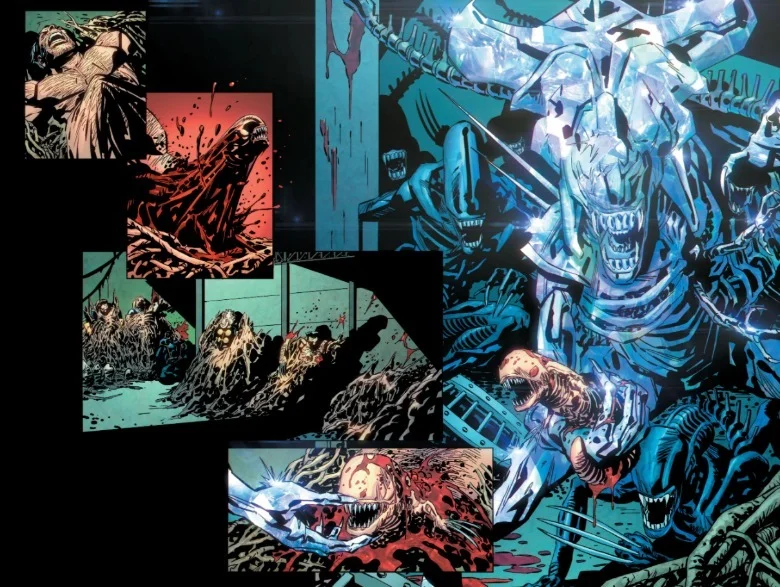
The creatures born from the mutants carry traits from their hosts. Wolverine’s offspring have his claws, and the hive queen has Emma Frost’s diamond skin. The idea extends a pattern familiar from the Alien films: in Alien 3, for example, a Xenomorph born from a dog moves on four legs. Here, the host’s characteristics become superhuman abilities, giving the crossover a way to make adaptation itself part of the threat.
That distinction matters because a copied trait can affect more than a single fight. Claws change how a creature attacks; diamond skin changes what can hurt it. The comic’s premise invites the reader to ask what other powers might be passed along, while keeping the answer tied to a concrete danger already established in the story.
Multiple Man could change the scale of the threat
In issue #1, the mutant Xenomorphs attack the X-Mansion. Their acid blood melts through Colossus’ steel form, and they capture Jamie Madrox, better known as Multiple Man. Issue #2 spells out the danger: if the aliens gain his power to create duplicates, they could reproduce without living hosts. That would undermine the usual bottleneck in Xenomorph reproduction, which depends on finding bodies to serve as hosts.
Here's the thing: a power that creates more bodies could turn a contained outbreak into a multiplying force. The comic hasn’t established that the aliens can use Madrox’s ability, so the threat remains a possibility rather than an accomplished fact. But the possibility is enough to make his capture strategically important. The numbers here are underwhelming only if you treat the power as a simple combat trick; in this story, it could alter how the infestation spreads.
One consequence is clear. A team trying to contain the creatures would have to consider not only where the Xenomorphs are, but whether each encounter gives them another useful trait. (And this is the part most people overlook.) The mutants’ abilities may become a resource for the hive even when the X-Men use those abilities to defend themselves.
The Brood offer a telling comparison
The X-Men have faced another parasitic alien species for decades: the Brood, created by Claremont in 1982. Like Xenomorphs, the Brood infest hosts and can absorb mutant powers. But they speak and share a hive mind, and their infection transforms hosts into Brood drones. Their origins also draw on Alien, making the new crossover a pointed collision between two different versions of the same horror premise: one built around a communicative species and one around the brutal danger of the individual creature.
X-Men ’97 recently leaned into that connection with a Brood story inspired by Aliens. The comic’s Xenomorphs bring a distinct danger: acid blood. In a flashback in issue #2, Cyclops blasts a chestburster heading for his face. It bursts, spraying acid across him and killing him. A victory measured in seconds can still carry a lethal cost.
The comparison helps clarify what this crossover is emphasizing. The Brood’s shared mind and ability to use hosts create one kind of sustained threat; the Xenomorphs’ acid blood makes even a successful attack hazardous. Add inherited mutant abilities, and the story gives the X-Men several problems that compound rather than cancel one another out.
What the premise means for the X-Men
The X-Men’s path to stopping the hive remains uncertain, but the central threat is already clear: these aliens can pair the Xenomorphs’ lethal biology with mutant abilities. If you're working through the series, the key question is whether the team can contain the outbreak before the creatures acquire powers that make containment harder. The premise is more significant than it looks because it turns the X-Men’s defining strength—their varied abilities—into a possible advantage for their enemy.
That tension gives the miniseries a useful source of suspense. The team can’t simply rely on familiar tactics if each host might leave the hive stronger, and the story has already shown that the creatures can challenge abilities as formidable as Colossus’ metal form. Whether the series will make Madrox’s power the decisive escalation remains to be seen. For now, the threat is the possibility that every attempt to stop the aliens could arrive too late to prevent them from adapting.
Issues #1 and #2 of Alien vs. X-Men are available now.


