 Five reviews this week circle different questions about art, memory, labor and history. The range is the point: a debut novel that turns internet saturation into myth; a meditation on what historical fiction can preserve; a biography that respects its subject’s opacity; a speculative story about surrogacy and work; and a history of California gold that argues the rush mattered as much as the metal.
Myth, media and survival
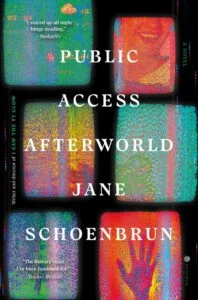 Junot Díaz sees Jane Schoenbrun’s *Public Access Afterworld* as a strikingly accessible debut from a filmmaker known for the unusual textures of *I Saw the TV Glow*. It reworks the Orpheus myth for an age shaped by screens and media, mixing political conspiracy, urban fantasy and a neo-slave narrative, with echoes of *Videodrome*, *The Matrix* and Neal Stephenson’s *Snow Crash*.
The book’s ambition could easily swamp its people. Díaz argues that Schoenbrun keeps the story grounded in the lives of marginalized characters instead. Jules is self-loathing and struggling with substance use; David can’t recognize the harm he causes; and Willa, in a separate 1940s Los Alamos storyline, lives with her scientist husband and becomes drawn to Rachel. Schoenbrun can even make a creature caught between dimensions feel devastatingly human.
The novel’s trans character Bethany becomes, in Díaz’s reading, a defiant “final girl”—to borrow Carol Clover’s term—a survivor who knows what it means to be trapped and belongs to a community under threat. The book’s answer to brutality is not escape, but the stubborn possibility of creativity, solidarity, laughter and love. Its call to “Find the receiver. Make it real” gives Díaz a way to describe a novel that makes the dreams and struggles of people long erased or maligned feel present.
–Junot Díaz on Jane Schoenbrun’s Public Access Afterworld (The New York Times Book Review)
What survives in a historical novel?
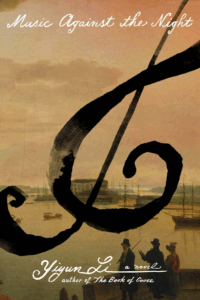 Kevin Power’s review of Yiyun Li’s *Music Against the Night* starts with an uneasy proposition from Philip Hensher: historical novels may fade from view as literary taste moves on to fiction about contemporary life. Hensher’s example is pointed—who now favors Walter Scott over Jane Austen?—but Power resists treating posterity as the measure of a book. Gore Vidal’s image of the future as “a permanent darkness where no whistle sounds” captures the review’s focus: what matters is what readers and writers make of history now.
Li’s novel doesn’t fit the familiar costume-drama version of historical fiction. Power describes her prose as so assured that its craft seems invisible, while art itself remains a central concern. The book also touches on the death of a child, a subject connected to Li’s own writing about the suicides of her sons, Vincent and James. The novel doesn’t dwell there; instead, it sets the passions of life against art’s austere indifference. Its narrator says death rewards minor artists, while conveying life demands major talent. Power’s verdict is clear: Li has that talent.
–Kevin Power on Yiyun Li’s Music Against the Night (The Guardian)
Let Emily Brontë remain unknowable
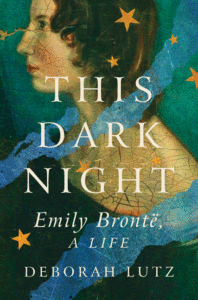 Sarah Chihaya approached Deborah Lutz’s biography *This Dark Night* with reservations: Emily Brontë, as remembered by Elizabeth Gaskell, was happiest on the moors and deeply wary of strangers. Brontë left little that would satisfy biographical curiosity; she seemed to want readers to know almost nothing about her, even hiding behind a name that wasn’t her own.
Lutz doesn’t smooth over that distance. Her biography asks more than it answers, which may frustrate readers looking for a trove of fresh facts or a neat explanation of Brontë’s character. Chihaya finds that restraint a strength. It avoids turning Brontë into someone conveniently familiar.
The familiar image of Emily as a wild “moor nymph” owes much to Charlotte’s grief-shaped preface to the second edition of *Wuthering Heights*, which cast her sister as a feral genius and “native and nursling of the moors.” Lutz instead places Brontë in the particular world that formed her. Chihaya comes away without feeling she knows Emily better, but with a stronger sense of the environment that runs through her writing. The biography’s case is modest and persuasive: understanding the limits of what we can know about another person can itself bring them closer.
–Sarah Chihaya on Deborah Lutz’s This Dark Night: Emily Brontë, A Life (The Nation)
Surrogacy, wages and power
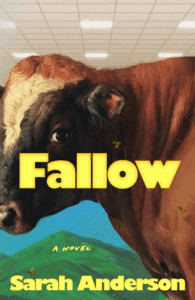 Anna Louie Sussman reads Sarah Anderson’s *Fallow* as speculative fiction with an uncomfortably familiar premise: a near-present shaped by surveillance capitalism, where a technological or political turn could make an already plausible fear feel immediate. That territory has particular force for feminist writers, especially those conscious of how much hard-won progress women could lose.
Anderson’s novel complicates the standard dystopian story of surrogacy as inevitable exploitation. It treats gestational work as part of a broader labor market and asks who holds power over whom. Natalie’s circumstances and relationships change; so does her understanding of the work. Sussman draws on a 2022 paper in the *International Journal of Comparative Sociology*, which argues for “surrogacies” in the plural to reflect how pregnancies, families and power dynamics differ. The point is sharp: there’s no single ethical template that fits every case.
That argument connects to feminist demands for wages for housework and other forms of “life-making”—bearing and raising children, caregiving, cooking, cleaning and sustaining families, work often performed by women without pay. Sussman sees *Fallow* directing its critique toward exploitative employers and an economy that devalues workers, rather than toward Natalie’s choice of labor. That’s a more complicated argument than a simple warning about surrogacy, and a more useful one.
–Anna Louie Sussman on Sarah Anderson’s Fallow (The New Republic)
The gold mattered. So did the hurry.
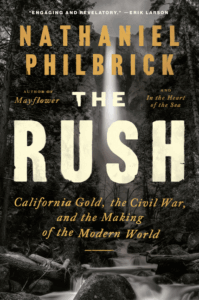 Kathryn Schulz’s review presents Nathaniel Philbrick’s *The Rush* as a sprawling account with two linked claims. California’s gold discovery sparked contests over wealth, land, labor and political power that helped bring on the Civil War and shape its outcome. But Philbrick’s larger subject may be the rush itself: the speed and appetite for novelty that sent Nantucket whalers west and, he argues, became a lasting feature of American life. The surviving fragment ends as Schulz connects that impulse—from the forty-niners to a planned Anthropic IPO—to the country’s changing future.
–Kathryn Schulz on Nathaniel Philbrick’s The Rush: California Gold, the Civil War, and the Making of the Modern World
Philbrick’s book is strongest when it stops trying to make the Gold Rush explain us. The parallels with today’s AI boom are vivid: early arrivals can reap huge rewards, infrastructure promises riches, and the rush brings political turmoil, environmental damage, and stark inequality. But resemblance doesn’t establish cause. The book shows no clear line from California in the 1850s to today’s technology frenzy, and the scramble for wealth hardly seems uniquely American when Australians, French, Chinese, and Chileans also raced to California.
Here’s the more persuasive lesson: when extraordinary wealth seems within reach, people often move, compete, cheat, boast, devise new ways to extract it, make rules, break them, and fight for control. The Rush captures that disorder best through the people who drove it, enabled it, resisted it, recorded it, or sometimes checked it. The history doesn’t need to predict the present to matter.
A history shaped by its surviving evidence
Philbrick’s broad account of California from 1848 to 1878 may be more compelling than the book’s attempts to connect the Gold Rush to modern life. Those decades offer more than enough drama on their own. But the cast of characters is uneven, and the historical record has blind spots: more than ten thousand Chinese workers helped build the transcontinental railroad, yet no diary or letter from any of them has been found. Their absence leaves a vast gap in the story. Philbrick recognizes that gap, though the book’s limits stem more from the material it includes than from what has gone missing.
The book also struggles to hold together two different ambitions: tracing historical causes and exploring the psychology and culture of a gold rush. Its larger account of California keeps pulling it away from both. That tension points to a question bigger than Philbrick’s argument: does the past have to explain the present to deserve our attention? Sometimes its value is simply in seeing what happened, in all its specificity. As Kathryn Schulz puts it, the past can be “its own kind of gold”—hard to reach, valuable, and worth letting shine.
–Kathryn Schulz on Nathaniel Philbrick’s The Rush: California Gold, the Civil War, and the Making of the Modern World (The New Yorker)


