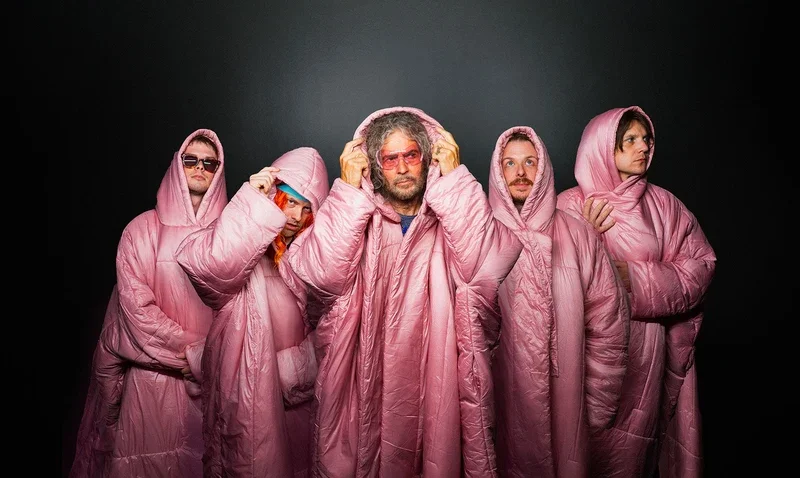
Family fears behind the surrealism
Family fears and surreal images shape the Flaming Lips’ first album in six years. The Teardrop Throbs, due Jan. 22 through Jack White’s Third Man Records, grew in part from frontman Wayne Coyne’s realization of how much his two young sons matter to him. That domestic starting point gives the record’s more outlandish images a personal anchor: the strange scenes aren’t detached bits of psychedelic theater, but ways into anxieties that are difficult to state plainly.
Coyne describes the moment in an account of the album’s making: parked at Trader Joe’s, he glanced at his 3-year-old son Rex asleep in the back seat and misread a sign for the Children’s Health Foundation as “Children’s Death Foundation.” The error stirred memories of his mother comforting families after the loss of a child, and the fear of facing such a loss himself. “It occurred to me there will never be anything in my life as important as my two little boys,” he writes. The episode is small and ordinary until the misread sign changes its meaning; then it opens onto a fear that has no neat resolution. That turn from the mundane to the frightening is a useful key to the album’s emotional method.
From a film song to a werewolf question
The album’s opening track, “Throb,” began with Coyne’s interest in The Night of the Hunter. He wanted new slide guitarist Adam Judd Slaughter to reproduce the children’s song “Pretty Fly” note for note. Slaughter’s longer introduction and ending led the band elsewhere: guitars and drum machines joined the arrangement, and the idea grew into an extended song about a bleak hospital. Coyne rewrote the lyrics, leaving only a fragment of the original inspiration. The path from a precise musical instruction to a larger, darker piece suggests a band willing to let an initial idea become raw material rather than a blueprint. The hospital setting also sits close to the album’s recurring tension between childhood and vulnerability.
“God Will Control the Werewolves,” the album’s new single, started with a question from Coyne’s sons, Bloom and Rex. While the family played hide-and-seek beneath a full moon, the boys asked if werewolves might come for them. Coyne’s attempt to reassure them became the song’s central idea. For its sound, he pictured “kind of Pink Floyd Dark Side of the Moon BUT Syd Barrett is still in the band.” That reference points toward a recognizable mix of expansive atmosphere and instability, though the song’s origin is more intimate than its title might suggest. The threat is imaginary; the work of calming a child is not.
Other songs turn to addiction and persistence. “You’ve Got Brain Damage” reflects on the effects of drugs and alcohol. “Instructions on How to Draw an Eyeball or How to Deal With a Loved One Who Is Addicted to Drugs” takes its cue from Coyne’s refrain: “I don’t know why but I just keep on trying again and again.” Its unusually long title places a practical-sounding instruction beside a problem that can’t be solved by following directions. That friction suits the subject: caring for someone with an addiction can involve repetition, uncertainty and a stubborn refusal to stop trying. “Every Teardrop Cried” began with a line he wrote during the parking lot episode that also helped inspire “Throb.”
Two nights in five cities
Longtime collaborator Dave Fridmann produced the record. The band will mark its release with two-night runs in Nashville, New York, Los Angeles, Chicago and London. Each city gets a different set concept: the first night pairs The Teardrop Throbs with “songs from the 20th century,” apparently drawing on material released between 1986 and 1999, including songs the band has never played live. The second night will feature album tracks performed “in a new way” alongside songs from 2002 to 2020.
The structure gives the release shows a role beyond introducing new material. Listeners can hear the album placed beside songs from different stretches of the band’s catalog, while the promise of a new arrangement gives familiar tracks room to shift. The description leaves the precise set lists and what “in a new way” means open, which is part of the appeal and a practical uncertainty for anyone choosing a night. If you’re working in this space as a fan, the two-night format asks you to think of the shows as distinct programs, not repeat performances.
Meaning left to the listener
Coyne resists assigning the songs a single interpretation. “I don’t really believe any song has a fixed meaning,” he writes, adding that he doesn’t want his music to have one. His aim is for the songs to work through listeners’ moods and feelings, leaving room for personal readings. That stance fits material drawn from family fear, addiction and children’s questions: each subject carries more than one emotional register, and a surreal image can hold those tensions without settling them. Here's the thing: openness can invite listeners in, but it also puts more weight on performance and sound to give each song shape.
This is more significant than it looks. The album’s personal origins don’t require every listener to share Coyne’s circumstances; they provide a point of departure for broader feelings about care, fear and helplessness. And yet, the songs’ titles and images can also resist easy translation. A werewolf, a hospital and an eyeball aren’t tidy summaries of their subjects. They’re entry points. (And this is the part most people overlook: leaving room for interpretation doesn’t make the writing empty; it asks the listener to do some of the work.)
The new album follows a Nov. 13 Rhino/Warner release: a 20th anniversary reissue of the Flaming Lips’ At War With the Mystics. The reissue and the new record place catalog history and new work close together in the band’s schedule, while the concert plans connect those past songs to the present set lists. No grand theory required. Just two records, old and new, meeting onstage.
The scheduled live dates are:
Jan. 22-23: Nashville (Brooklyn Bowl)
Jan. 26-27: New York (Irving Plaza)
Feb. 23-24: Los Angeles (Bellwether)
Feb. 27-28: Chicago (Metro)
April 2-3: London (O2 Shepherds Bush)


