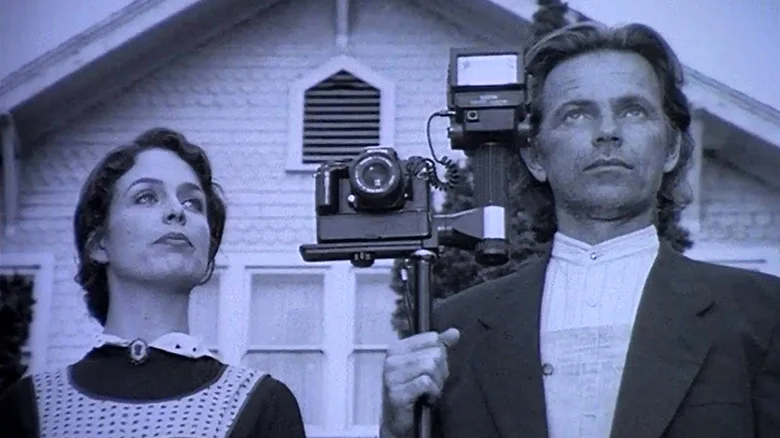
Before serialized mysteries became a familiar TV format, Nowhere Man built an entire season around one man’s vanished identity. The 1995 UPN series gave Bruce Greenwood a compelling lead and paired conspiracy drama with episodes that could turn sharply surreal. It lasted just 25 episodes, leaving a distinctive ’90s sci-fi series easier to remember than to find.
Created by Lawrence Hertzog, the show arrived in the wake of The X-Files’ success. Mark Snow, who composed music for The X-Files, also wrote Nowhere Man’s score, but the series took a different structural bet: instead of reserving its larger mystery for occasional story arcs, it made that mystery the spine of the whole season.
A life erased, a photograph left behind
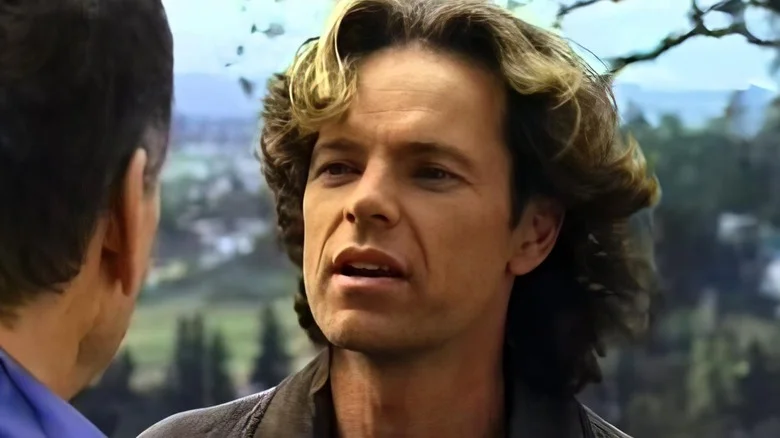
Greenwood plays Thomas Veil, a photojournalist whose work puts him in the path of a hidden power. A year before the series begins, he photographs American soldiers and a man with a cigar hanging four people from a tree during a military conflict in South America. Veil titles the image “Hidden Agenda.”
Then, without warning, his ordinary life collapses. His bank account is gone. His best friend is dead. His elderly mother doesn’t know him, and his wife, Alyson (Megan Gallagher), treats him as a stranger. Even the employees at his regular restaurant have no memory of him.
Veil is left with no reliable identity and one clear lead: the photograph. A shadowy organization pursues him, apparently intent on finding the image’s negatives. The group’s motives emerge only in part during the season, keeping the threat unsettlingly vague as Veil travels across the country trying to uncover what happened.
The setup recalls both The Fugitive and Patrick McGoohan’s 1967 series The Prisoner. In the latter, a former spy is held by an opaque organization that wants to know why he quit; in Nowhere Man, the pursuit centers on Veil and his negatives. The show makes the connection explicit in an episode where Veil enters a quiet suburban spy enclave and takes the name Number Six, McGoohan’s character’s designation.
Conspiracy stories with a surreal edge
The central mystery gives the series a through line, but its individual episodes take Veil into stranger territory. One sends him into a television production that appears to recreate his erased life. Another finds him undercover at an elite school where students face subliminal mind control. In a particularly offbeat story, a nursing home’s residents are being made younger and trained as assassins.
That mix is part of the show’s appeal. Nowhere Man isn’t a straight horror series, yet it often leans into dread, uncertainty, and the possibility that Veil can’t trust what he sees. It has the appeal of an ongoing conspiracy mystery, but it’s willing to let a week’s detour become bizarre on its own terms.
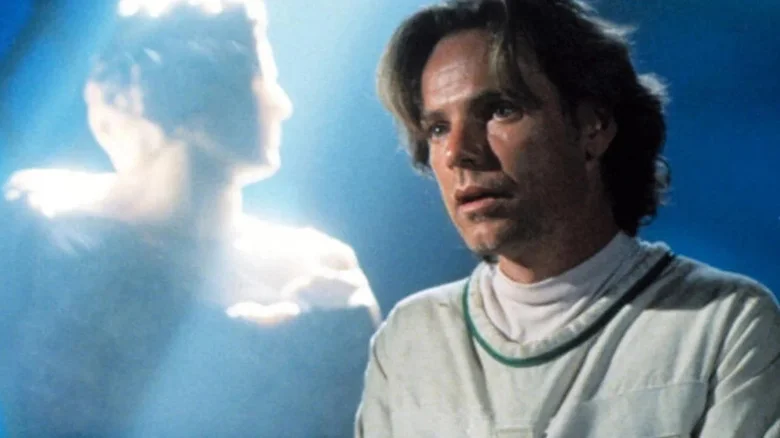
Its guest cast adds another layer of ’90s-TV recognition. Carrie-Anne Moss appears as a photographer Veil falls for after drugs and hypnosis distort his perception. Dean Jones plays a man claiming to be Veil’s father, a particularly apt bit of casting given his resemblance to Greenwood. Bryan Cranston turns up as a sheriff investigating Veil in a murder case, while Maria Bello plays a woman who helps him recover from an injury. Dean Stockwell, Roy Brocksmith, and Dwight Schultz also appear.
A short run, still worth tracking down
The pilot had support from Variety’s John P. McCarthy, who praised Greenwood as an appealingly “fit” lead and credited director Tobe Hooper with giving the story an effective pace. McCarthy thought viewers would want to return. The series’ one-season run suggests that enthusiasm didn’t translate into a large enough audience.
For fans of serialized television, the show now sits in an interesting spot between The X-Files and later mysteries such as Lost. Its 25 episodes offered a sustained question, but also made room for self-contained stories that tested the premise in unexpected ways. That combination gives the series a voice of its own, even when its conspiratorial framework recalls earlier work.
Nowhere Man isn’t available on streaming, though a DVD box set may turn up on the second-hand market. The series has also been listed among forgotten ’90s sci-fi shows that still hold up. For a program built around a man whose records and relationships disappear, its own hard-to-find status feels fitting. The stronger reason to seek it out is simpler: Greenwood’s grounded performance gives its strange premise a human center.