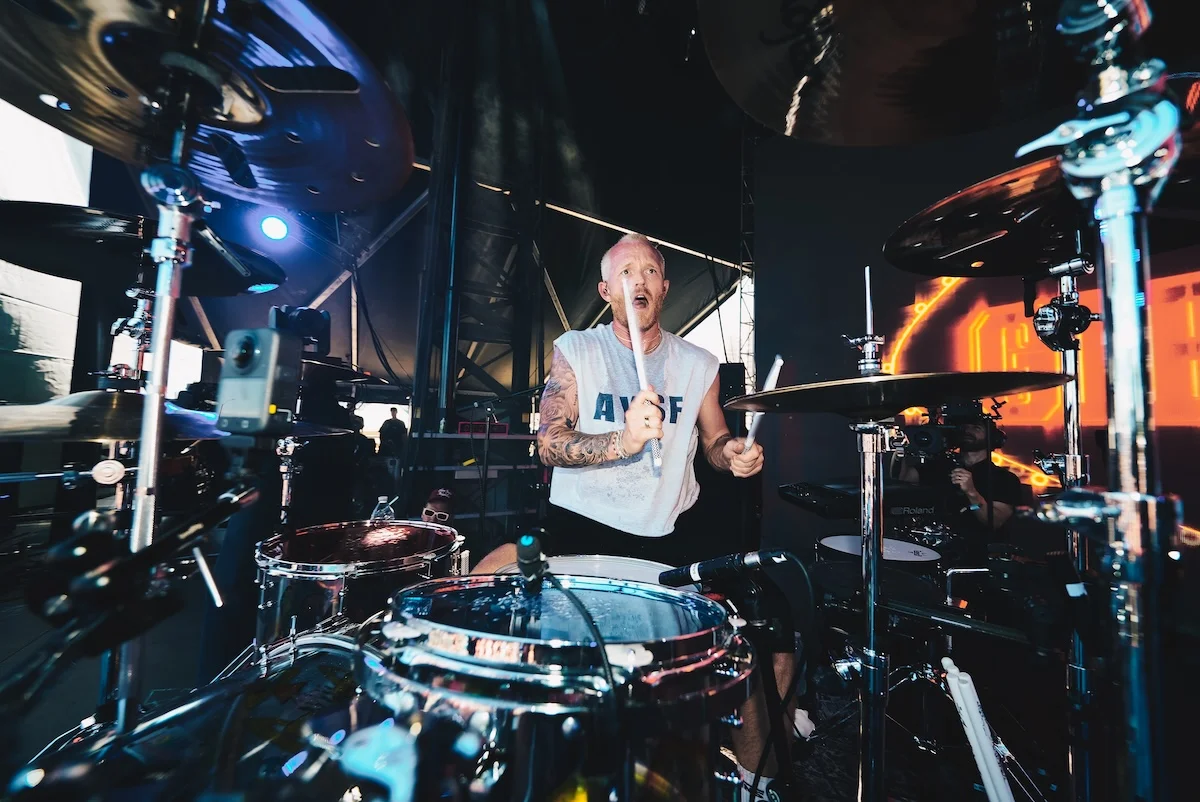
Nick Gross is proof that having the right mentor can change your life. When the drummer and founder of Gross Labs Foundation was just 16 years old, he and his band Open Air Stereo played their first festival at the 2003 edition of KROQ’s Weenie Roast in Irvine, California. The experience led to a chance encounter with Blink-182’s Travis Barker that became fundamental.
“He was my idol at the time,” says Gross. The then-teen figured he’d shoot his shot and asked Barker if he’d be willing to provide drum lessons at his house. Surprisingly, Barker said yes. “I took lessons with him in his basement, and I was hooked,” says Gross. “I knew that this is what I wanted to do for the rest of my life.”
More from Spin:
- Jeff Ament’s Pearl Jam Photo Book Digs Beyond The Famous Shots
- Bette Midler Named 2026 Recipient Of Woody Guthrie Prize
- Seth MacFarlane’s American Songbook Obsession Meets The Muppets
In the two decades since, Gross has made it happen. The career drummer currently sits behind the kit for his band Girlfriends and is a member of Goldfinger. He’s also worked with MGK and Avril Lavigne. Three years after the serendipitous Weenie Roast experience, in another stroke of luck, he was cast into the third and final season of MTV’s reality series “Laguna Beach”—filmed in the town where he still lives with his family.
“Our whole class was in season three, we were the new crew that came in after the first two seasons,” he explains. “The band was a main character of the show, and I was the drummer. So, it was a good senior year. It was a lot of fun.”
Blessed with all of these fortuitous experiences, Gross wanted to find a way to pay it forward. “I wanted to figure out something to give back to the local community,” he said. It started in his own recording studio.
Right after “Laguna Beach,” at 18 years old, he signed a deal with Sony Epic Records and founded a studio in L.A. “It’s a small 1,800-square-foot building in the center of Hollywood, and I started to partner with nonprofits in town to bring kids through the space,” he recalls. The idea was to provide young people with immersive experiences where they could see firsthand how a studio worked and have the chance to write lyrics and record music and make videos.
“I looked at what I was passionate about and the things that I was doing in my life and used what I had to leverage this idea of community impact,” says Gross.
Eventually, he founded an edtech platform, Find Your Grind, in 2017 that centers around pathways for workforce career development for kids. “The goal is so that they can have a more defined understanding of who they want to be and not what they want to be,” says Gross.”
The idea for Find Your Grind quite literally hit him in the face. “I drove past a wall in downtown L.A. that had those words spray painted, and I was like, that has such a cool ring to it,” Gross remembers. “I figured we have to do something with that as a brand that helps kids find their purpose, find their grind, find the thing that drives them. Because I always felt super grateful to have found the drums and found an identity through music early on and wondered, how do we help other young people figure out what that is for them?”
It’s not necessarily just music he focuses on, either. Gross Labs Foundation is the impact arm of Gross Labs, a cultural and lifestyle investment company that supports a portfolio of more than 50 companies across sectors from education, sports, real estate, and hospitality to media and entertainment. Gross Labs Foundation uses those connections and a series of education-tech software to offer kids shadowing and mentorship opportunities with a range of partners like the Tiger Woods’s TGR Foundation, the Anaheim Ducks, and the Vans Warped Tour. There’s also a series of videos—about 150 in total—filmed byGross and his team that feature industry leaders talking about their love for their careers and how they got there.
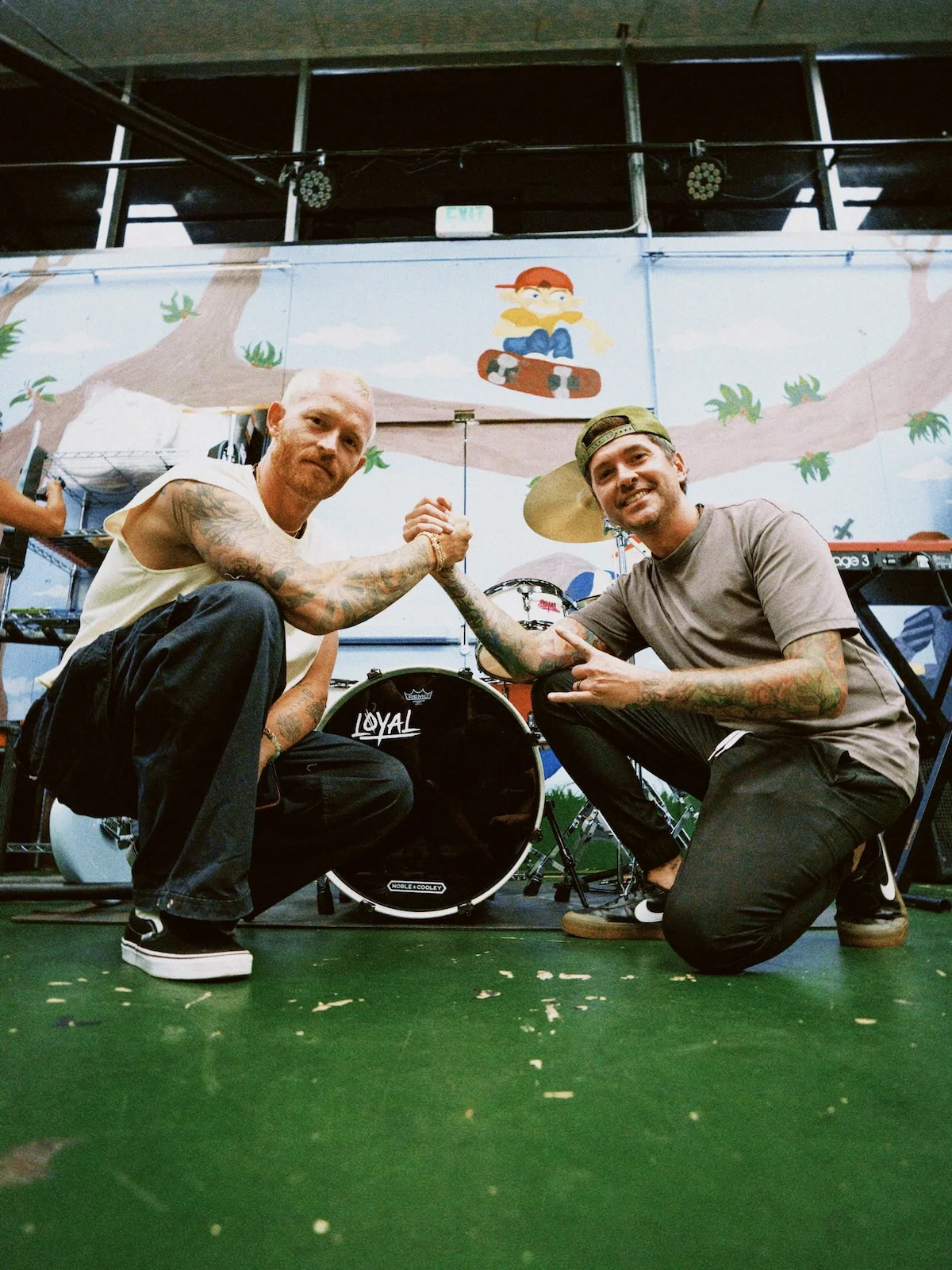
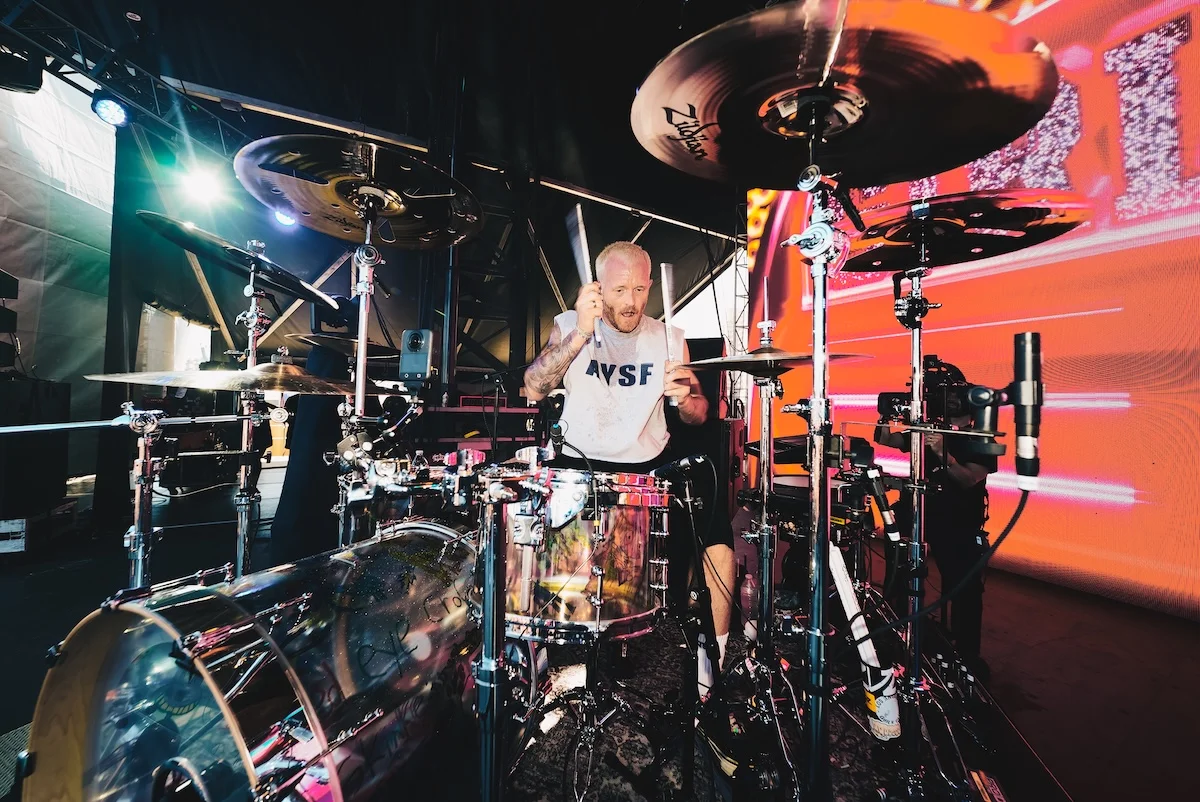
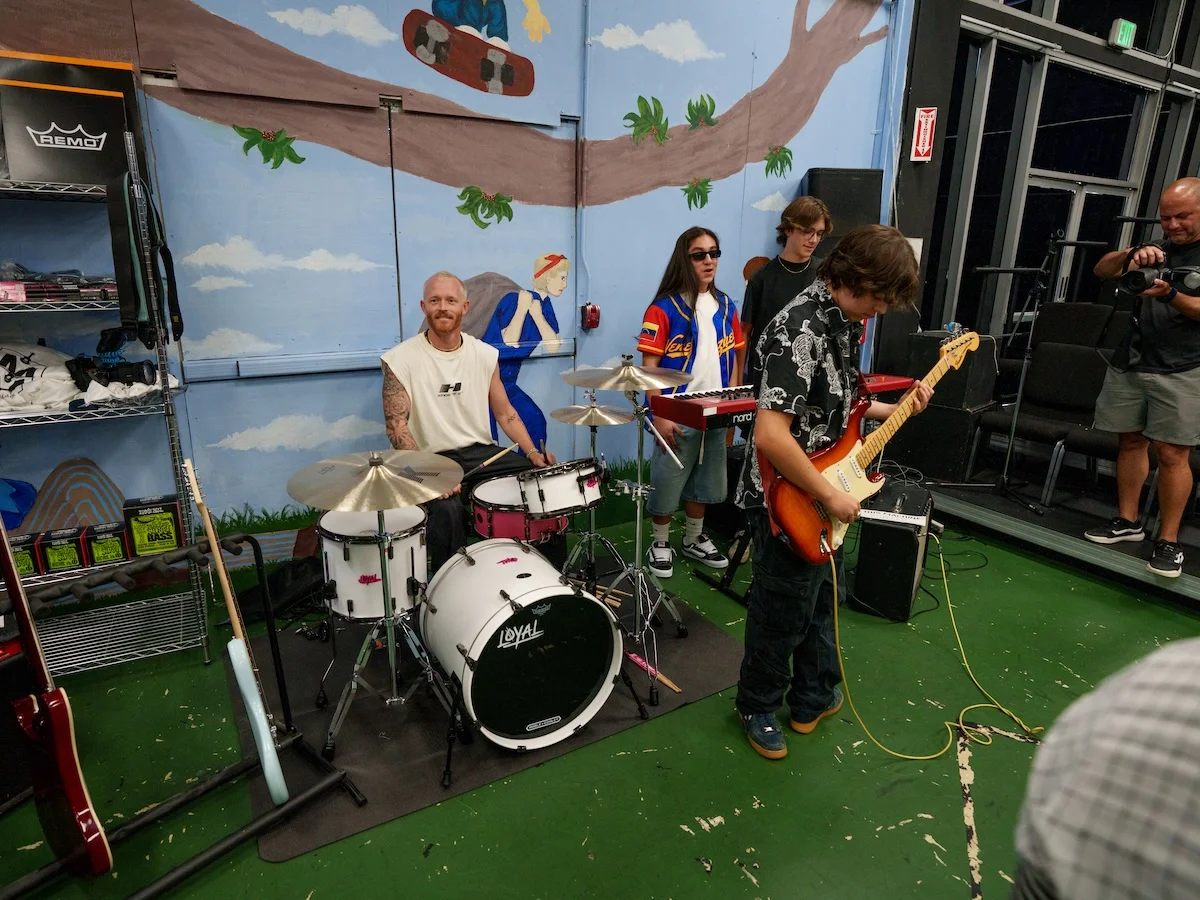
But Warped Tour, in particular, is where the tenets of Gross Labs Foundation really come to life in a very tangible way. This is the second year the nonprofit has partnered with the festival and the Loyal to the Craft organization (also keen to inspire the next generation of music artists) in an onsite activation. At the recent Long Beach edition, held July 25 and 26, more than 50 students from a local School of Rock chapter were able to head to Warped, perform on a festival stage together, and hear real stories and advice from artists including Alkaline Trio’s Tosh Peterson and Sleeping with Sirens’ Matty Best. Peterson even jumped on stage to play drums with the students during their Paramore cover.
Even before the festival kicked off—where Gross also performed with Goldfinger—he and Loyal to the Craft’s Mike Ciprari paid a visit to the CHAMPS Charter High School of the Arts in nearby Van Nuys, where 60% of students are from low-income households and 70% identify as minorities. In addition to talking with music students, and an impromptu performance from Gross, the duo presented the school with $50,000 of donated music gear.
“It’s our way to inspire, activate, and give kids access and exposure,” says Gross. “A lot of times that’s where it all starts.
Ciprari adds, “Because of Gross Labs Foundation, hundreds of young people experienced something they may never have had access to otherwise: real mentorship, real stages, real artists, and real belief in themselves.”
The proof is in what happens after. Several students from the 2025 Warped Tour program came back and reported that they had the confidence to audition for bands and pursue careers in music.
Nicholas Cerda, a 14-year-old aspiring musician who took part in the Long Beach weekend as an apprentice of the Gross Labs Foundation and Loyal to the Craft team commented, “This weekend gave me a different perspective on the music industry. I learned how much work happens behind the scenes, met incredible people, and gained confidence by being trusted with real responsibilities. It made me even more excited to keep pursuing music and to find ways I can make an impact.”
Below, Gross discusses more about how the foundation works, how it aims to fill gaps in the American education system, and what he hopes students ultimately take away from the experience.
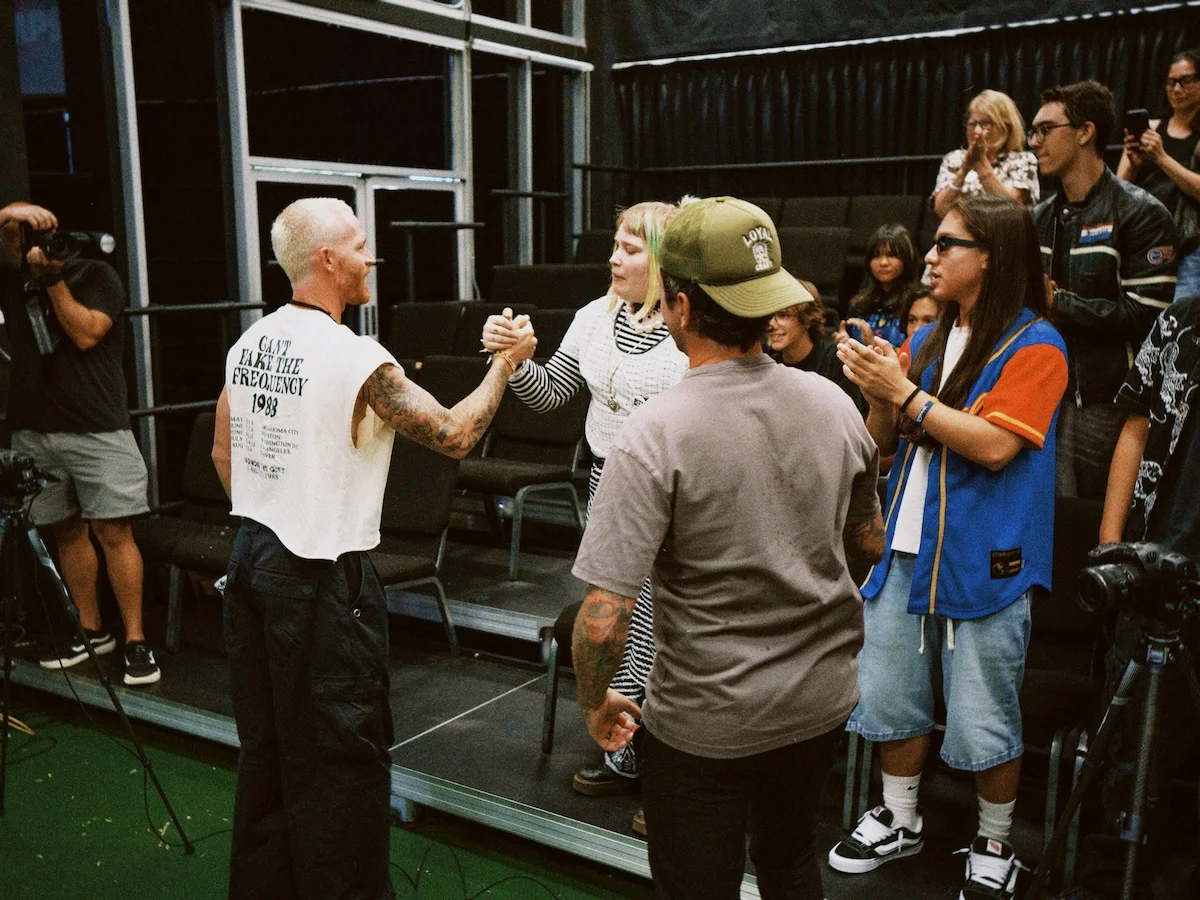
In a perfect world, the programs that Gross Labs Foundation is doing would already be initiated in schools, whether it’s helping kids figure out what kind of careers they want to go into or having the access to instruments and music education. What were you seeing lacking in classrooms that made you want to try and fill the gap?
It kind of goes back to when I had filmed all this content around careers. I jumped on a bus, it was me and 10 other people, and we set out on a speaking tour in high schools and colleges for 15 months. I got to immerse myself inside schools with thousands of kids on a monthly basis. From that, I had a really good perspective and firsthand vantage point of what kids struggle with and what the conversations are like. It always comes down to the same things: ‘I’m not understanding how what I’m learning in school is going to pertain to real life.’ ‘How are the things I’m learning here going to help me get my first job?’ Or, ‘how do I apply this in a real-world context?’ The world has changed so fast and education has been too slow to keep up with that. What these kids are learning in school and what they’re being taught does not always match up to the reality of what the world is really like. Back in the day, it used to be a lot more linear in terms of perfect grades, perfect college, perfect job, perfect life. That’s what we saw lacking and what we wanted to bring to the surface with Find Your Grind initially. So many kids just don’t know what is possible or how to go about doing it.
How does Gross Labs Foundation actually work? Do you have your own programming or is it mostly finding partners to work with?
We find partners to give grants to. We don’t have specific programming that we’ve developed necessarily in-house, but we find really great partners and help activate new ideas with them or support existing options, from mental health initiatives to sports and entertainment and entrepreneurship programs. A great example is we gave a grant to the TGR Foundation that has afterschool learning labs around the country with unique models around letting kids explore potential career pathways. With the grant, we helped redesign their classrooms and built a recording studio in one of their facilities. But they also started implementing Find Your Grind’s software in their learning labs. So, kids actually use our products in addition to us giving them a grant to support their programming. In essence, we’re trying to activate our philanthropy, not just give passive grants.
With the music programs, specifically, like Warped Tour, who are some of the recording artists you’ve worked with that jumped on to be mentors?
Deryck from Sum 41 comes through a lot. New Found Glory too. My band Girlfriends also does a lot. What was cool about Warped Tour in Long Beach is we also launched a whole drum company alongside Loyal to the Craft. I’m a partner with Mike Ciprari in a new drum company called Loyal, where the whole business model is based on selling custom drums with the money going back to our nonprofits so we can fuel more impact. We’re doing custom drumkits and all kinds of stuff that will be under this brand. I have the second Loyal kit ever and I had my 6-year-old son ‘design it. I took all his art from kindergarten and plastered it all over the kit. Mike was also the founder of SJC drums 20 years ago and they’re notorious for building the most custom and fun drums played by everyone from Twenty One Pilots to Green Day. So, we’re super excited about this concept.
Another important part of what you do is show kids that there are other jobs in the industry beyond just being a performer. Why is it important to you to integrate that knowledge too?
Whether it’s the music industry or sports or education or healthcare, I think most kids think that they have to be the top performer. You know, the LeBron James or Selena Gomez in their field. And they’re shocked to find out that there’s hundreds of other avenues, especially within the music industry, that they can pursue. They just need to be shown that.
Ultimately, what do you hope kids take from the programs steered by Gross Labs Foundation?
I hope it inspires more young people to go into the music world and the music industry. And I hope they learn that if you’re passionate about a creative side to your life, whether it’s music or a different art form, you don’t have to be afraid to stick with it and go after it. You can’t be what you can’t see, so to have these experiences is essential. So many of the kids we work with can come from difficult backgrounds that have no opportunity and no mindset around what’s possible. Whether it’s music or something else, we hope that seeing how other people have found their paths helps. Even if just 10% of kids go and find something meaningful for their life, that’s what drives us.
To see our running list of the top 100 greatest rock stars of all time, click here.