Harriet Clark's debut novel, The Hill, serves as a deeply personal exploration of familial ties and the complexities of legacy. What sets this narrative apart is not merely its plot but its deeply autobiographical roots. Clark, whose mother, Judy Clark, was a notorious activist involved in a bank robbery that resulted in a tragic loss of life, channels this tumultuous history through the eyes of her protagonist, Suzanna. Set in New York City, the story chronicles Suzanna's harrowing journeys to a hilltop prison to visit her mother, enhancing the emotional depth of a coming-of-age tale that diverges sharply from conventional narratives. James Wood, in his review, encapsulates its essence as a “brilliantly deprived bildungsroman,” indicating its departure from the feel-good trajectories typically associated with youth-centric novels.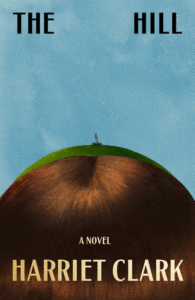
An Intimate Exploration of Absence
At the heart of The Hill is the theme of maternal absence and its effects, not only on children but also on the guardians left to navigate the treacherous terrain of family secrets and public shame. In the novel, Suzanna's encounters with her grandparents evoke a profound sense of neglect, as they remain wrapped up in their own “intricate dramas of departure.” Clark adeptly mirrors this disconnect with her minimalist dialogues, where pivotal conversations about the mother’s crime are relegated to vague descriptors. Phrases like “what your mother did” tend to gloss over the complexity of her past, demonstrating how families manage their traumas in silence, imposing their narratives upon the younger generation without fully exposing the truth.
Creative Legacies and Personal Struggles
This novel does more than recount the life of an estranged daughter; it serves as a lens into Clark's own family legacy, marked by her mother's involvement in a high-profile crime that looms over the narrative. This autobiographical thread offers a dual perspective: both as an author trying to disentangle herself from her mother's notoriety and as a character grappling with the weight of familial expectations and societal judgment. The slow revelation of Suzanna's mother being incarcerated for a crime that ended a life speaks volumes about the broader implications of crime, justice, and familial loyalty. Such intricacies make the reading experience contemplative, questioning how public figures are often reduced to their most unfortunate acts, while their familial relationships and humanity are overshadowed.
A Broader Context: Crime and Identity
Clark's work comes at a time when narratives surrounding crime, identity, and society are increasingly prominent across literature and media. The exploration of how one's family history, marked by criminality, informs one's identity resonates within contemporary discussions about systemic issues, including mass incarceration and social justice. Her book invites readers to consider how intertwined personal histories can be, and how they shape perceptions of self and others. The instinct might be to fixate on the sensational aspects of her mother’s past, but that reading risks overlooking the novel’s rich character development and nuanced emotional landscape. 
Implications for Writing and Authenticity
Clark's narrative strategy—adopting a minimalist approach to depict trauma and absence—also raises questions regarding authenticity in storytelling. It speaks to a broader struggle many authors face when they draw from personal histories. How can one maintain a genuine narrative while being weighed down by the shadows of past actions? The answer may lie in how such stories are articulated and received, challenging readers to engage with discomfort while unraveling their own understanding of identity and morality.
Looking Ahead: The Weight of Inheritance
Ultimately, Clark's The Hill stands as a testament to the enduring impact of familial legacies. As it grapples with themes of identity through the lens of criminality, it invites readers to reflect on how personal narratives shape collective understandings of justice and morality. This novel not only showcases Clark's literary prowess but also elevates discussions around the implications of inherited trauma—how silence can often speak louder than words, leaving an indelible mark on generations. As such, any forward-thinking discourse in literature will benefit from exploring these labyrinthine relationships that define who we are, transcending mere storytelling to engage in a deeper conversation about the human experience.