We Tested 13 Slow Cookers, and There's Only One We'd Trust With Our Chili and Pulled Pork
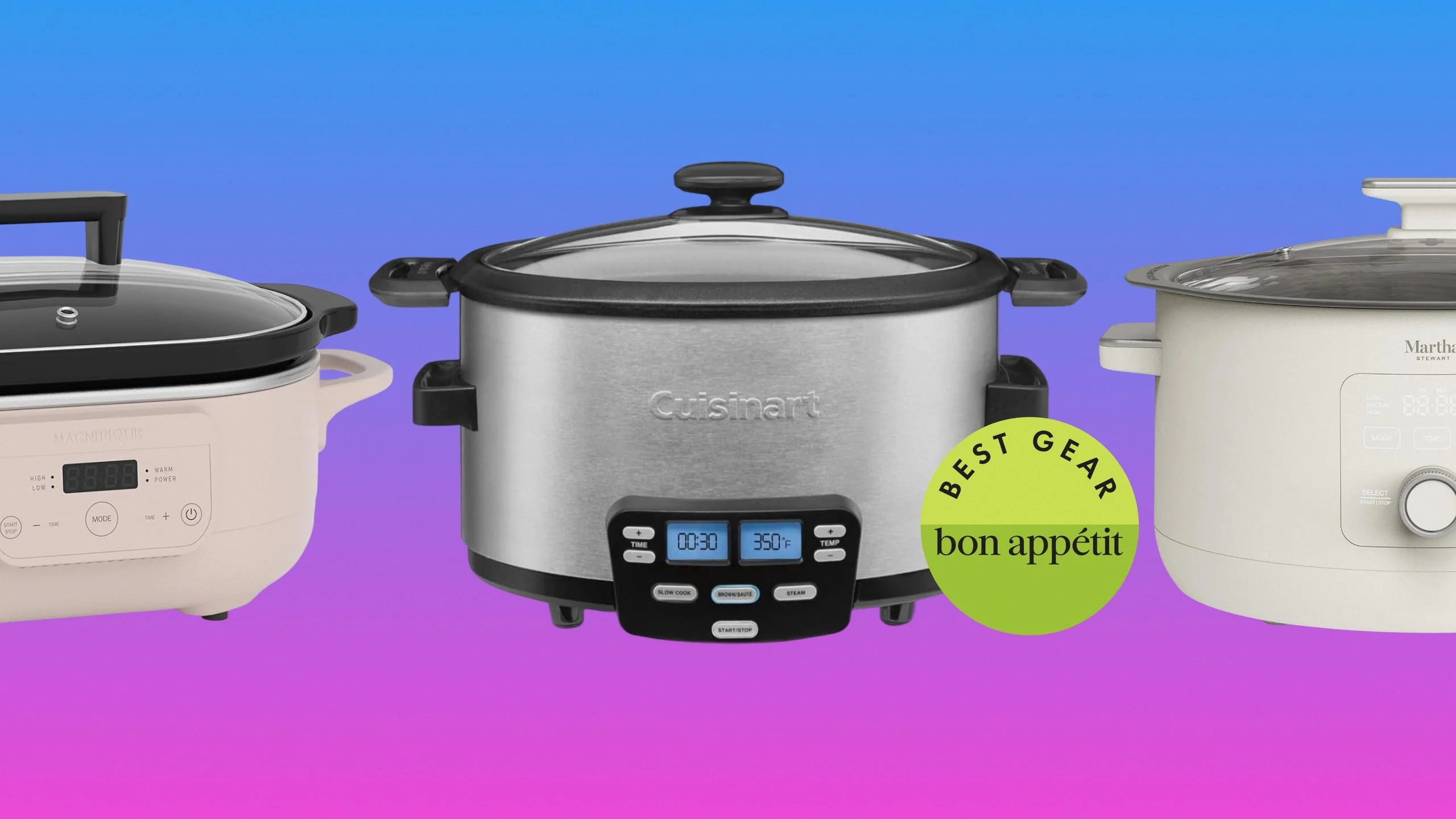
These days, you can’t throw a rock in a big box store’s countertop appliance aisle without hitting a piece of “foolproof cooking” kitchen tech, from air fryers and Instant Pots to smart toaster ovens and sous vide circulators. (You also shouldn’t throw rocks in a big box store.) But as you process the promises and pitfalls of all of these app-enabled, A.I.-assisted devices, you might be overlooking an old-school “set it and forget it” culinary workhorse: The slow cooker.
Our top pick
- The best slow cooker: Cuisinart 6-Quart Cook Central 3-in-1 Multi-Cooker
A slow cooker is a handy and unsung extension of your stovetop when cooking for big events like Thanksgiving or Super Bowl Sunday. You can braise short ribs, make chili, or cook a whole chicken. The list goes on!
My fellow Bon Appétit contributors and I have tested several models of slow cookers and have landed on one slow cooker to rule them all. Read on for our top pick, and keep scrolling for more on our methodology, plus the other machines we tested and enjoyed.
New in this update: We got our hands on a batch of new slow cookers, including Martha Stewart's gorgeous 8-Quart Nonstick Ceramic Slow Cooker that is perfect for batch cooking and party prep, as well as the $70 GreenLife Ceramic Slow Cooker, which bodes well for a budget tool. While these impressed us, some of the new models we tried (the Crock-Pot Programmable 7-Quart Cook & Carry with Sous Vide and the Ninja Foodi PossibleCooker Pro) fell flat.
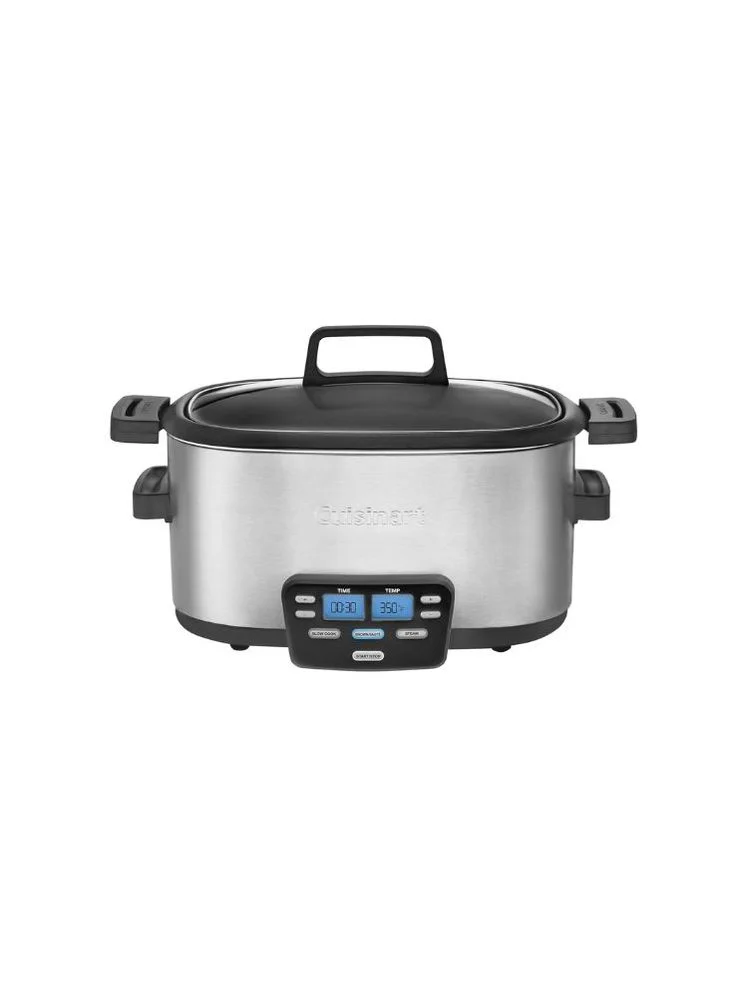
The best slow cooker: Cuisinart 6-Quart Cook Central 3-in-1 Multi-Cooker
Pros and cons
Pros:
- Consistently cooks tender, flavorful meals
- Affordable and dependable
- Brown/sauté function lets you sear before slow cooking
- Steam function with included steamer rack adds versatility
- More temperature and time control than most slow cookers
- Stainless steel exterior stays relatively cool
- Available in multiple sizes (3.5- and 7-quart)
Cons:
- No locking lid for easy transport
- PTFE nonstick coating (might not appeal to some users)
Specs
Dimensions: 10.5"L x 16.5"W x 8.7"H
Weight: 14 lbs
Settings: Keep warm, simmer, low, high, brown/sauté, steam
Materials: Stainless steel, aluminum
What we love: The Cuisinart Cook Central is a simple and well-designed slow cooker that produced batch after batch of succulent chicken and tender stewed vegetables. It excelled in our tests, and at a reasonably affordable cost, we consider it a consistent and dependable choice for both casual and frequent slow cooker cooks.
The Cook Central has a modest, functional suite of settings. The slow cook function has warm, simmer, low, and high settings—warm is for keeping already cooked food at a palatable 165°F for up to 8 hours, while simmer, low, and high cook at preset temperatures of 185°F, 200°F, and 212°F, respectively. The machine also features a brown/sauté function for searing meats prior to slow cooking, a key step if you want appetizing pulled pork and pot roast. That function brings the machine up to 350°F in roughly 6 minutes. If you’re into steaming (like a lot of chefs are lately) the Cook Central has a steam setting and comes with a steamer rack for when a craving for Pork and Shrimp Cabbage Rolls or Smoky Orange Chicken Thighs strikes.
In comparison to older models of slow cookers, the Cook Central gives the user greater control over time and temperature. You can set the cook time for up to 24 hours, and adjust the temperature anywhere between 150–400°F. In general, the more transparency a machine has about temperature, the better.
Build-wise, it has a nice stainless steel exterior that doesn’t get too hot. And it comes in a variety of volumes, including 3.5 quarts and 7 quarts.
What we’d leave: We wish that the Cook Central came with a locking lid, since transporting slow cookers for things like potlucks and sporting events is definitely a thing. We also aren’t in love with the inner cooking pot, which has a PTFE-based nonstick coating. However, these coatings remain common in lower-temperature cooking appliances (including many name-brand rice cookers), and that worries less than high-heat applications.
How we tested slow cookers
Food temperature
To assess how a slow cooker would treat both meats and veggies, our primary food-based test was making Slow Cooker Green Chicken Chili, which includes whole chicken thighs (that ideally shouldn't hit an internal temp above 195ºF) and large cubes of sweet potato, which can easily end up either intact or mushy. We cooked this recipe at two temperatures—on high for four hours and on low for six hours—and compared the results (and appeal) of each batch
Water temperature
In order to understand the programming and temperature presets more completely, we also did a water test, measuring the changes in temperature throughout the cooking process of each machine after the first 30 minutes, and then each hour thereafter. According to the USDA, slow cookers shouldn’t hold food in the “danger zone” between 40ºF and 140ºF for too long, and, according to the Michigan State University Extension, the ideal peak temperature for a low setting on a slow cooker should be around 185°F. We also paid close attention to which slow cookers brought water up to 212ºF which, if you remember high school science, is the temperature at which water boils. Some cookers’ high settings are preset for this temperature, so if you’re in a “rush” and need food cooked in, say, four hours, you’re essentially boiling the hell out of it. We’re here to slow cook our dinner, not ruin it.
How we judged slow cookers
Not every appliance that can “slow cook” is a “slow cooker.” There are a lot of multi-cookers on the market offering a slow cooker setting, but we’ve found that they often produce different results. We also found that recipes written for slow cookers don’t always translate well to multi-cookers. This was especially true for Instant Pot pressure cookers, which are just too different to compare. They certainly have a purpose, but if you’re wondering why we don’t recommend Instant Pots in this review, that’s why.
Additionally, there are quasi-slow cookers like the Ninja PossibleCooker which looks like a slow cooker but can crank up the heat to do more, so we judged it based on its slow cooking capabilities. Here’s what we looked for in the slow cookers we tested:
Ease of use
Slow cookers are all about convenience, so we looked for models that were simple, intuitive and easy to use. We appreciate programmable temperature settings and extra cooking features like brown/saute and keep warm, but don’t want too many.
Design features
Ideally, a slow cooker won't take up too much space on the countertop and be reasonably lightweight for easy transport (but we’ve noticed a trend away from circular toward oblong pots, even in smaller capacity units). We also made note of whether the cooking pots were stoneware or coated aluminum. While stoneware is typically heavier, we aren’t crazy about some of the nonstick coatings that appear on aluminum pots, so we factored that into our decision as well. Glass lids are a fine alternative to metal ones, so long as they seal well to prevent too much moisture from escaping. Locking lids are handy if you plan to tote your slow cooker to parties, but it wasn’t a dealbreaker, as standalone straps are available.
Cooking capability
We wanted slow cookers that delivered tender, succulent meat, and soft-but-not-disintegrated vegetables and beans. Temperature control is important, not just for producing food that tastes good, but for food safety as well. A slow cooker should reach 185° on the low setting, and shouldn’t linger too long in the “danger zone” under 140° where bacteria can thrive. On the other side, a slow cooker on low should remain below 212° to avoid boiling any liquid and overcooking.
More slow cookers we tested and liked
GreenLife Ceramic 6-Quart Nonstick Slow Cooker
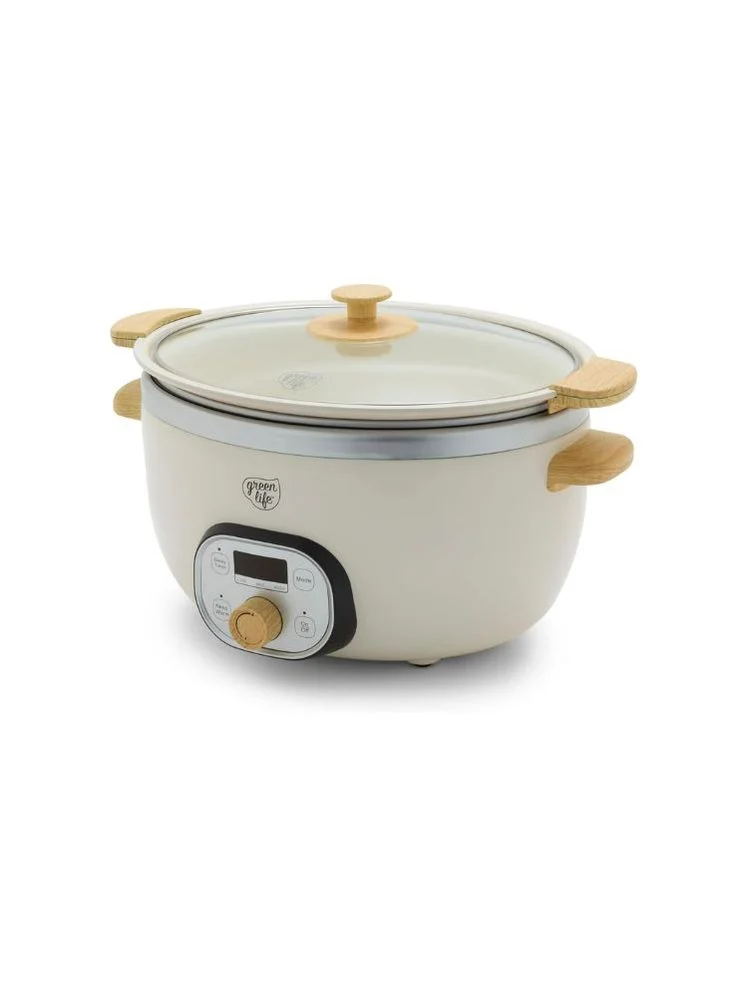
If you need a simple, occasional slow cooker, this inexpensive model from GreenLife might be the one. It’s lightweight and pretty compact despite its oblong shape, with a deep, tapered pot that keeps food in contact with cooking liquid (and is also stovetop-, oven-, and dishwasher-safe). It has three temperature settings (plus a delay function), and I found both the “Low” and “High” still produced moist chicken and toothsome but fully cooked sweet potatoes.
It comes in eight different colors, and the faux wood knobs and side handles of the cream and gray options add a little touch of variety to the overall look. However, the way those handles are attached to the cooking pot also create a few more crevices for moisture and reside to hide. The ceramic coating was pretty easy to clean, but the main thing I don’t like about ceramic-coated metal pots is that they can scratch pretty easily, especially if you forget and accidentally use a metal spoon. Additionally, the exterior of this cooker ran a little hot without any kind of plastic base or foot between it at the countertop. Perhaps counterintuitively, the “+/-” knob on the front is only used for setting the time, not the temperature. Finally, there is no “start” button on the display, a minor bug that some cookers have where you just have to trust that setting the time and temperature is also starting the cooking cycle.
Magnifique 6-Quart Programmable Slow Cooker
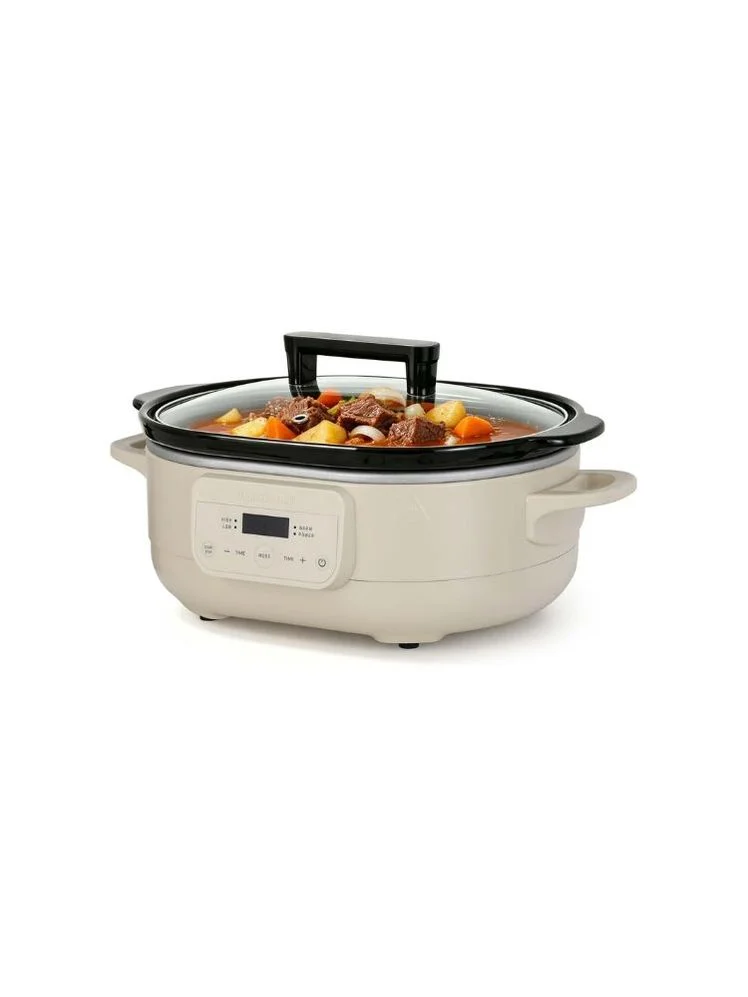
This affordable slow cooker, at around $70, hits all the marks when it comes to user-friendliness and visual appeal (it comes in a few satin-finish colors). The buttons, including “start/stop” and even a power “on/off” button, are easy to navigate and the backlit display is easy to read. It’s not any smaller than larger pots on this list, but it is a bit shorter, which made it feel a little less in the way.
That said, with a shallower pot, I’d be worried about fitting a whole chicken inside it. I wasn’t thrilled about the cooking pot’s oblong shape with a flat bottom and nearly straight sides which can reduce food contact with cooking liquid. Probably the biggest worry this slow cooker gave me was its plastic-y smell, even on my third round of cooking with it. However, that seemed to subside by the fourth. And both the high and low batches of chili were cooked adequately without being overcooked—oddly enough, the low setting produced slightly overdone veggies compared to high, but nothing I would have sent back at a restaurant.
Read our full review of the Magnifique 6-Quart Programmable Slow Cooker.
Martha Stewart 8-Quart Ceramic Nonstick Slow Cooker
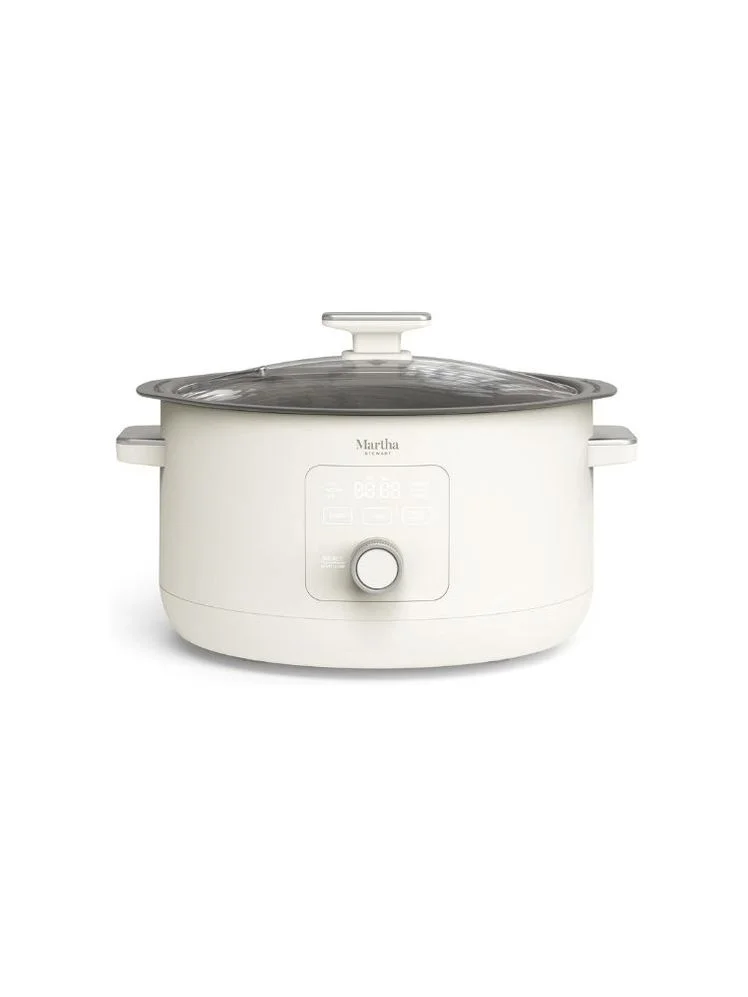
You might find this 8-quart cooker a little large for your weeknight needs, but it does have a deep tapered, ceramic-coated aluminum pot that is easy to clean and only has a rolled rim, so not too many pesky cracks or seams to clean. And it looks good on your countertop with its satin finish and five different color options. One thing that sleek design fell short on was display readability which was challenging in bright situations. But the display does tell you all the pertinent info, including which temperature setting you’re on (there are six, including “Reheat,” “Simmer,” and “Warm”). The central knob used to select hours and temperatures is also a start/stop button so you can control when everything gets going.
However, my other qualms are that—despite this unit having three main temperature settings— think it runs a little too hot even on “Low” as softer sweet potatoes came out mushy, though the chicken thighs fared better the lower and slower I cooked them. Finally, the pot has “handles” that are part of the formed shape, but not a separate (ideally insulating) material, so pulling the pot out while it’s still hot is a bit of a challenge despite the manual saying it’s both oven and stovetop safe.
Greenpan 6-Quart Slow Cooker
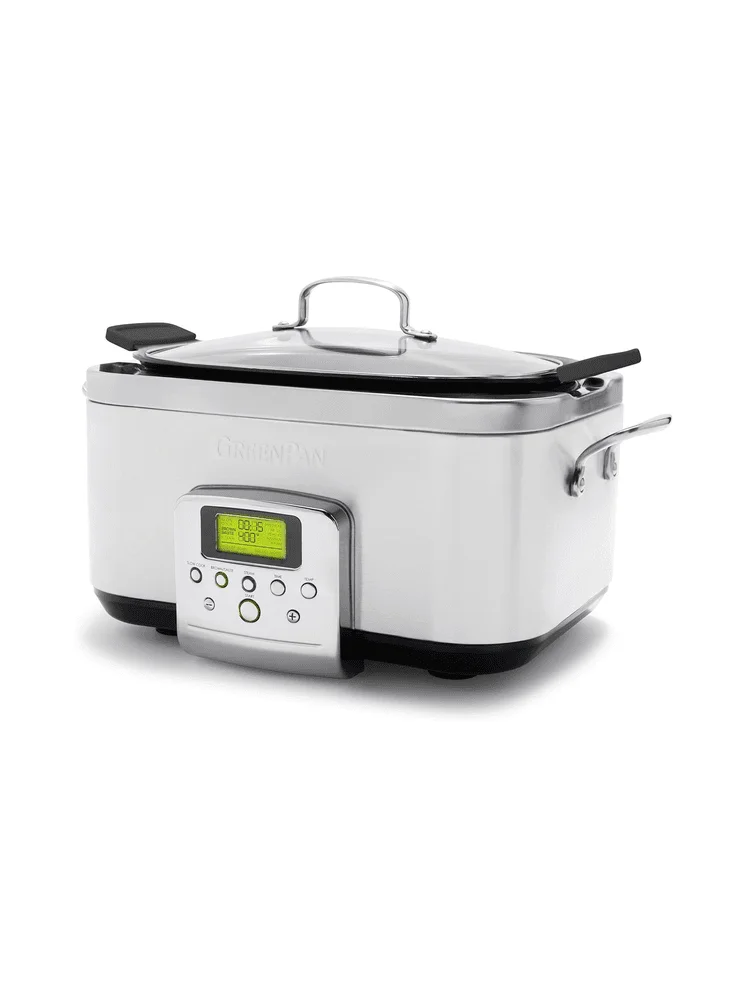
This slow cooker performed exceptionally well and is comparable to our winner. However, it costs nearly twice as much. It does come in a range of beautiful colors, though, so if aesthetics are worth the higher price point, we say go for it.
Hamilton Beach Set & Forget Slow Cooker
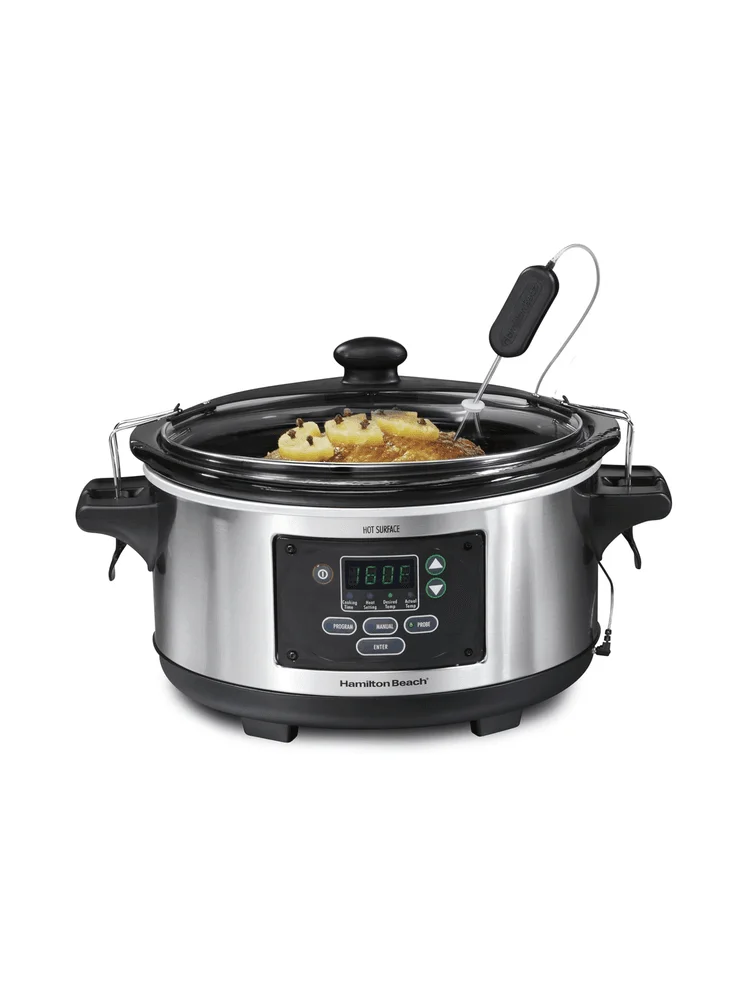
We liked but didn’t love this slow cooker. It comes with a locking lid and a temperature probe to tell you when your meat is done. While the latter is nice, we found that the difference in end result during our tests between slow cookers with a probe and slow cookers without was negligible. The issues with this model were its dimly lit digital display, which one tester found to be very difficult to see, and the fact that this machine gets quite hot on the outside when cooking, making it a bit uncomfortable to transport.
Slow cookers we don't recommend
I’d love to recommend a budget slow cooker like this Chefman, but unfortunately it didn’t perform consistently enough to make the grade. On “Low,” it crept up to 212ºF and, as expected, it overcooked the chicken and veggies. On “High,” it reached boiling, turning potatoes to complete mush and the chicken thighs to a stringy, chewy consistency.
Beyond that, it’s the details. There’s no start/stop button, the stoneware cooking pot lacks any kind of handles, and the timer seemed to lag about three to five minutes behind the actual cook time. The locking lid clips are nice additions, but they disengage with a button that’s just inside the perimeter of the base unit handles, meaning it could be easy to accidentally bump and disengage, say, if traveling in a car. The outer stainless steel shell construction is a little too flexible, raising long-term sturdiness concerns.
This is the original Crock-Pot design that most people are familiar with. A manual knob switches between low, high, and warm settings. While it is a classic, we’ve come to the conclusion, after testing, that we prefer programmable slow cookers with temperature displays over manual slow cookers. In the Crock-Pot's defense, we’ll note that many people prefer this model because they have found that programmable slow cookers get too hot. In testing, we did find that this slow cooker on the low setting stayed on the cooler side. After two hours on the low setting, the contents of this slow cooker reached 125°F, which, for food safety reasons, is not a temperature you want to linger around for two hours when cooking raw meat. While it did eventually reach a food-safe temperature of 170°F by the 4-hour mark, we preferred our winner, which got to a safe temperature much more quickly.
A problem consumers frequently voice about newer Crock-Pots is that they get too hot. Our temperature tests confirmed this: The low setting is calibrated to reach 212° rather than a more ideal 170°–190°F window. While meat turned out fine, we found that this Crock-Pot overcooked vegetables using the recommended cook times.
Like the other Crock-Pots above, this one suffered from high cooking temperatures. On “Hi,” it cooked at 212ºF for the last two (of four) hours; in other words, unappetizing, boiled food. Even on “Lo,” it came to a simmer by hour six. While the locking lid is convenient for tailgating and parties, the latching mechanism takes up a lot of real estate on either end of the lid and gets in the way, dangling down into the pot if you tilt it too much one way or the other. The silicone lip is also there for added security when transporting, a good feature, but it also required a bit more scrubbing to get the scent of the last cooked meal out of the rubber. Finally, the lid has two vent holes: one for placing the included wired probe thermometer when using this as a sous vide water bath, or using the probe to monitor meat doneness. But the placement of one such hole is too close to the lid handle, and I got a surprise burst of steam on my fingers or wrist one too many times.
This multi-cooker has a lot going for it, as it advertises replacing up to 14 different appliances. Consider it the Instant Pot of slow cookers, with functions for slow cooking, sautéing, steaming, sous vide-ing, braising, baking, and proofing. I focused mainly on the slow-cooker side, and sure enough, as we’ve come to expect with some of these digital multi-cookers, it runs very hot on “High,” boiling the food at or near 212ºF for the entire four hours. Oddly enough, the “Low” setting (peaking at 192ºF in the water test) gave me some of the most tender, perfectly cooked, and appetizing meat and vegetables.
But in the end, I think a slow cooker shouldn’t simply boil your food, even on High. Couple that with a larger than average vent hole letting off a lot of steam, I can’t say this works for all your slow cooker wants and needs. The pot also seemed to hold onto the smell of the last cooked meal, even after a thorough washing in warm soapy water. As for its other functions, a steaming and roasting rack is a separate accessory, as is a wireless thermometer. It does come with a spoon that nestles into the lid handle. I mostly found it got in the way of the, often, too hot to touch handle.
This slow cooker is huge, expensive, and heavy. Due to its wide dimensions, it requires a lot more liquid to submerge meats, and the lid did a poor job sealing in evaporation.
This was the cheapest model we tested. It consistently put out food with texture we found unappetizing.
Additional testing by Emily Johnson.