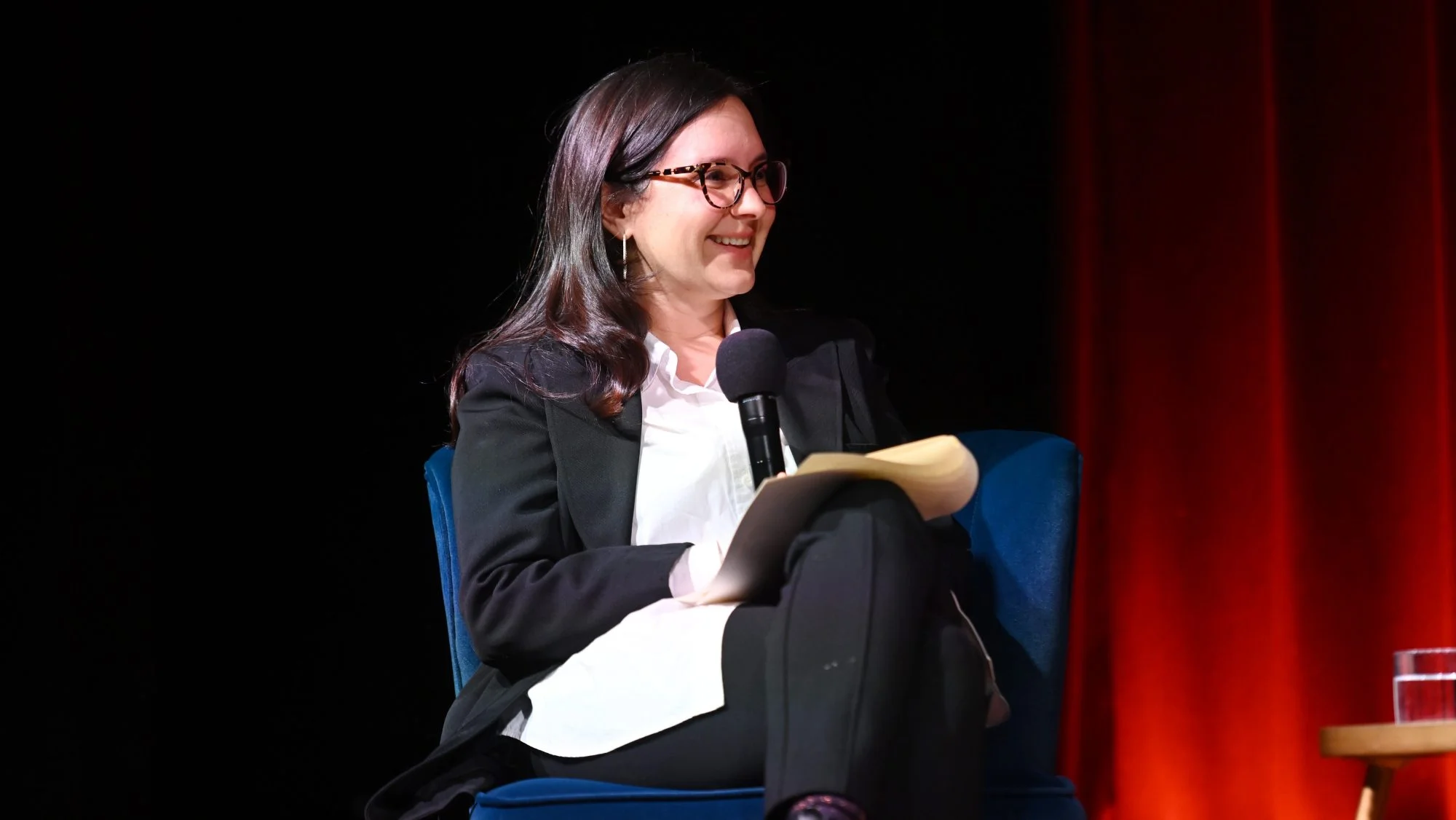
Children's Institute 2026: This Is a Book: PW Talks with Daniel Nayeri
In This Is a Door (Stonefruit Studio, Oct.), Daniel Nayeri—recipient of a Newbery Honor for The Many Assassinations of Samir, the Seller of Dreams, a Printz Award for Everything Sad Is Untrue, and a National Book Award for The Teacher of Nomad Land—uses text in innovative ways to weave his middle grade tale of an unlikely hero’s journey undertaken by a boy named Nothing, aka Ing. Accompanied by his dog, Pöppy and a mouse named mOmO, Ing descends from a city on a mountain into the underworld and back again in search of identity and purpose. Along the way, he discovers the truth about his parents, rescues the king’s son from eternal death, and comes to appreciate the meaning of life. Ahead of Children's Institute 2026, Nayeri, one of the conference's featured authors, spoke with PW about his latest project.
Where did the title of your book come from?
In March 2020, I was cooped up in my house like everybody else, and I was thinking about this thing that we always tell kids, as well as ourselves, that books are portals to other places, to other worlds. I started doodling in my notebook, and I wrote, “THIS IS A DOOR.” Then I moved the “A” over, and I thought, that actually looks like a door. The idea of using the text to make a door— the idea of the book itself being a door—made me think that I could make other words be what they are. It’s like in poetry, the carmen figuratum, or the shaped poem. Could I do this in the form of a linear story, a hero’s journey?
What was the creative process like?
I joke that I told my editor that I wanted to create an illustrated middle grade novel, but with no pictures. First, I drafted an outline, because I needed a certain kind of story in which the characters were moving through space and coming across a lot of things. Then I needed to design every spread. I did it by hand, using pen and ink, so that I could play with the shapes, because if I wrote the whole story and then went back in and took chunks, it’d feel inorganic. This book is all kinds of imagination along with the text.
Ing’s parents both failed him. Why did you choose to portray such flawed parents?
I don’t know if I ever think, let me make flawed parents. I just create a lot of flawed people. We also have a prince who’s fairly arrogant and self-centered. We have Nana, who lacks patience. We have Ing, who’s kind of a dullard. We have Pöppy, whose head is in the clouds. We have a lamplighter, who tries to trick Ing. And then there’s the feral girl. I think, in general, my perception is not that parents are flawed, but that people in general are flawed. The task of a good story is to humanize all these characters with their flaws. Ing finds himself at the beginning of the story without a lot of help; that’s why mOmO becomes so important to him -- because she’s an adult.
What do you hope readers take away from this book?
Stories are often beautiful because they’re useful, in the sense that at various times in our lives, there are certain ones that really mean something to us. That’s why I would love to give this book to someone who is on the precipice of something new. This Is a Door is about a young man going on a journey, but it’s actually about the mechanism by which we find our purpose. Back to your question about the takeaway: it would be asking yourself, what is your purpose, and how do you go about establishing that?
This Is a Door by Daniel Nayeri. Stonefruit Studio, $19.99 Oct. 27; ISBN 978-1-4642-4602-9