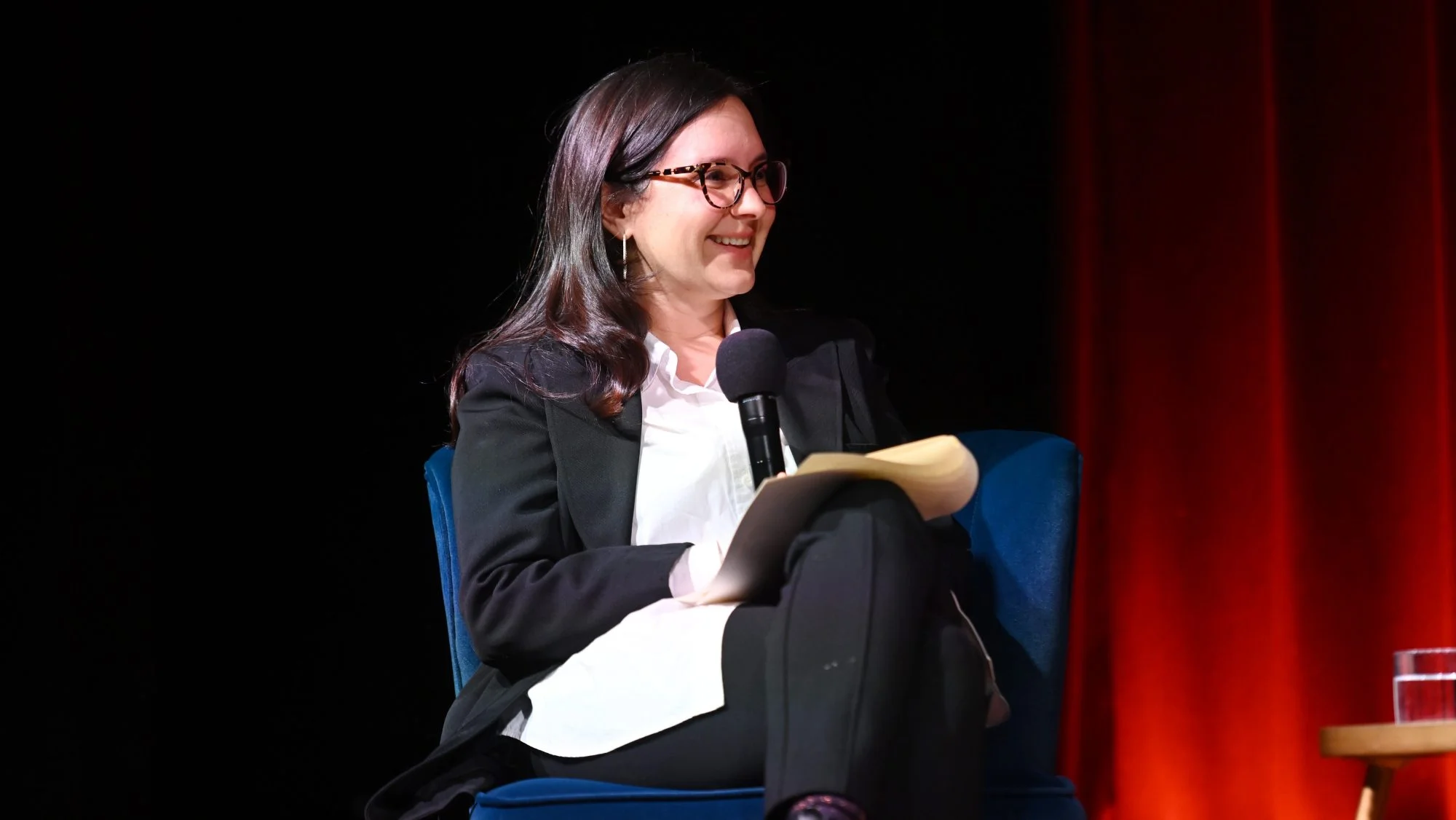
Min Jin Lee’s School of Hard Knocks
Min Jin Lee’s new novel—the third in her Diaspora Quartet—examines South Korea’s cutthroat education system
In 1976, when she was seven years old, Min Jin Lee emigrated with her parents and siblings from Seoul to New York City, in search of a better life, and was dismayed by what she found when she stepped off the plane. “I was so disappointed,” she says over Zoom from her home in Harlem. “I thought America was going to be like a 17th-century fairy tale or a Disney type of place. But it was just like Seoul, but not Korean. I thought it was going to be a storybook, and it wasn’t.”
Lee’s first impressions of the U.S. were a reality check, and set the stage for her development as a writer of social realist fiction. Over the past three decades, the author has been at work on the Diaspora Quartet, a four-book series about Korean and Korean American life that examines colonialism and capitalism, difficult immigrant journeys, intergenerational strife, disillusionment and inequality, and aspiration and faith. “No matter how long they stay in America—100, 200 years—Asians are still seen as foreigners,” Lee says. “I feel called to write about our human experience.”
The first book in the series was Free Food for Millionaires, Lee’s 2007 debut about a Korean American daughter of immigrants trying to make it in New York City in the ’90s. The second was Pachinko, her 2017 historical epic that tracks the lives of a Korean family that immigrates to Japan in the 1910s. Pachinko—which Lee wrote, on and off, for 30 years—was nominated for the National Book Award for Fiction and adapted into an Apple TV+ series. The two books together have sold more than 1.5 million copies, according to Cardinal, and have been translated into more than 35 languages.
Lee started writing American Hagwon, the third installment in the Diaspora Quartet, in 2016, and it’s now set to be published in September by Cardinal. It’s a multigenerational and multifamily story that focuses on South Korea’s competitive education system and the hagwons—pricey after-school academies also known as cram schools—that kids attend to boost their grades.
A big novel with a bigger heart, American Hagwon opens in 1992, when John Koh, a manager at a multinational trading company; his wife Helen; and their teenage kids, Mido, Bo, and DH, move back to Seoul from Sydney, where John had been stationed for work. In Seoul, families clamor for status, and education is a preoccupation, with kids routinely studying late into the night. Helen struggles to overcome financial roadblocks to get her children into a respectable hagwon, but things fall apart when the South Korean economy tanks in 1997.
The family then moves to Southern California, where a new kind of education begins. John takes a lowly job at a fish restaurant, and Mido works at an American hagwon and discovers a passion for teaching. But when tragedy strikes the Kohs, more and more responsibility falls to the younger generation.
Lee, the current New York State author laureate, spends years doing research and interviews for each of her books, and estimates that she conducted “easily hundreds” of interviews for American Hagwon, with hagwon teachers, parents, caregivers, and others.
“In every interview I’ve done with a Korean person of any background in the diaspora, they always talk about how important
education is,” Lee says. “Literacy and competence and exams are part of the cultural DNA. There’s an emotional attachment to the idea that you can escape and have social mobility if you’re smart.”
Reagan Arthur, Lee’s editor, says American Hagwon is a major achievement, both intimate and sweeping. “The amount of research Min did is remarkable. She repeatedly circled the globe to get everything right.”
Lee grew up in Elmhurst, a blue-collar neighborhood in Queens, and spent her summers working in her parents’ wholesale jewelry store and reading at the library. The author, who had chronic liver disease beginning in her teens (she has since recovered), received a BA in history from Yale in 1990 and a law degree from Georgetown in 1993. She met her husband, with whom she has a son, at a charity dance when she was in her 20s, and asked him to dinner on a whim weeks later. “I called the place where he told me he worked from a pay phone, and found him,” she remembers.
From 1993 to 1995, Lee practiced corporate law in Manhattan, before quitting to write full-time. She burned through her savings that first year, and wrote and discarded multiple manuscripts over the next decade (including drafts of what would become Pachinko), before publishing Free Food for Millionaires in her late 30s. “I felt like a failure for a long time,” she notes. She was stunned when she got her first book deal. “I kept thinking it wasn’t real.”
A slow and methodical writer, Lee averages one novel every 10 years, and never hurries the process. “It’s so stupid,” she says. “It’s completely against capitalism. If I write five books and die, I won. I’m never going to be as fast as other people.”
Peter Straus, Lee’s agent at RCW, says the author is an expert at delivering surprising moments in her work. “Min is fearless but sensitive,” he says. “She pulls you up short, and you can’t stop reading.”
Lee puts a premium on family, friendship, and duty, and that’s reflected in her work. Kind and disarmingly funny, she says she deals with depression, anxiety, and OCD, and sometimes prefers to limit her encounters with others. She prays and meditates, and enjoys her quiet time. “Having an office door is really important,” she says. She’s also pretty fond of swearing, making her totally relatable. “When I get really scared, I cry and swear. I’ve cussed in places I shouldn’t have cussed.”
Writing American Hagwon caused Lee to reflect more deeply about education in America, and the impact of AI. “We have all this technology being thrown at us, and we’ve become the beta testers,” she says. “We’re cognitively offloading. We’re becoming dumber, de-skilled. We’re losing jobs. We need to have a revolution with education and be part of the conversation about how to educate kids.”
And, she says, everyone needs to read because it’s life-changing. “I tell people, I’m not begging you to read either my books or anybody else’s, but I’m telling you that you’re going to be totally fucked if you don’t read.” (She lists Middlemarch and House of Mirth among her go-to classics.)
Lee is already at work on Marshall Plan, the fourth volume of the Diaspora Quartet, and is planning a memoir that will no doubt explore her immigrant journey. “Maybe it’ll be a memoir on Ozempic,” she quips, referring to her tendency to write long novels.
“I want my books to be deeply nourishing and entertaining,” she says. “If I could give credence to the human experience of Koreans abroad, then I feel like I did what I wanted to do.”
Elaine Szewczyk’s writing has appeared in McSweeney’s and other publications. She’s the author of the novel I’m with Stupid.