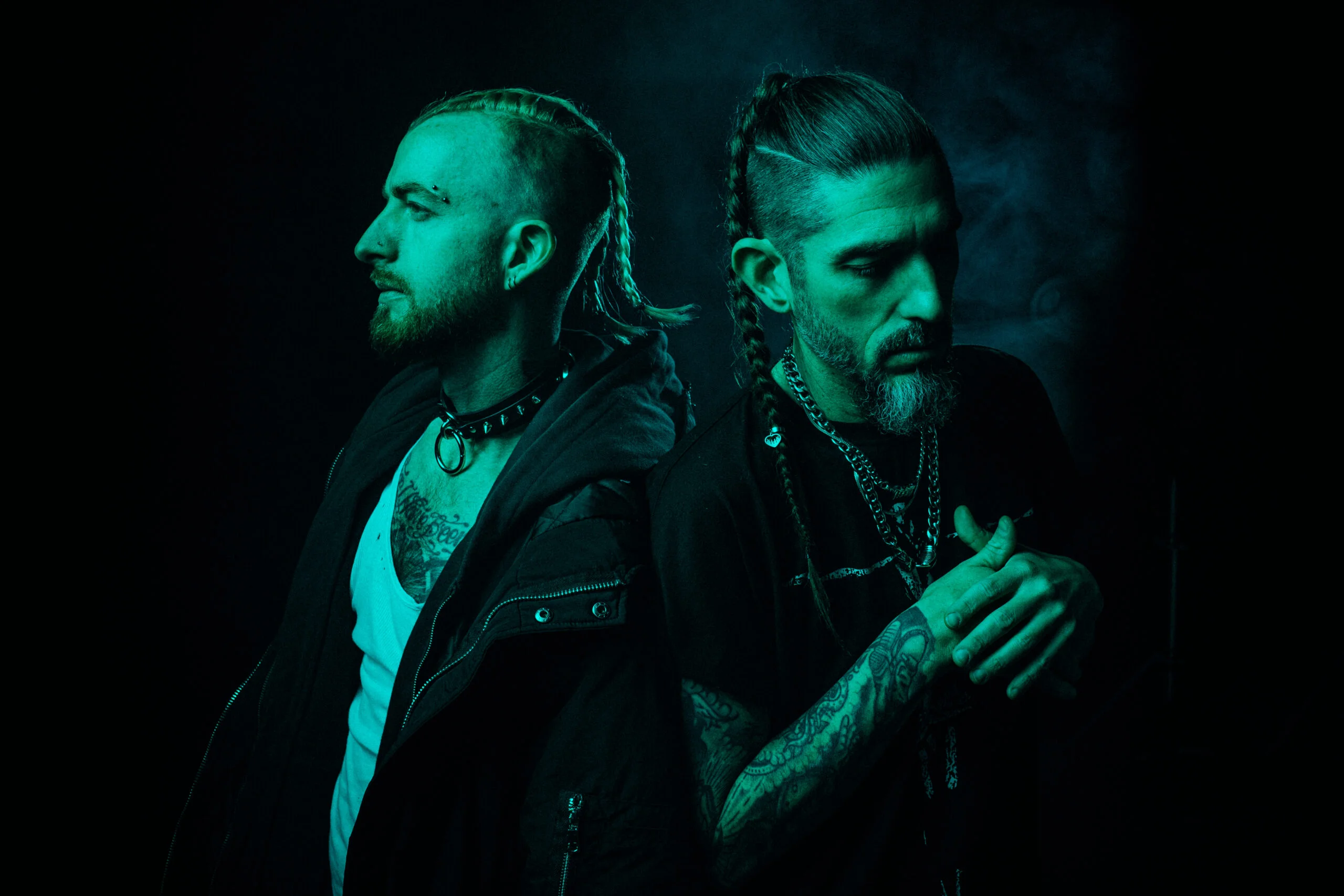
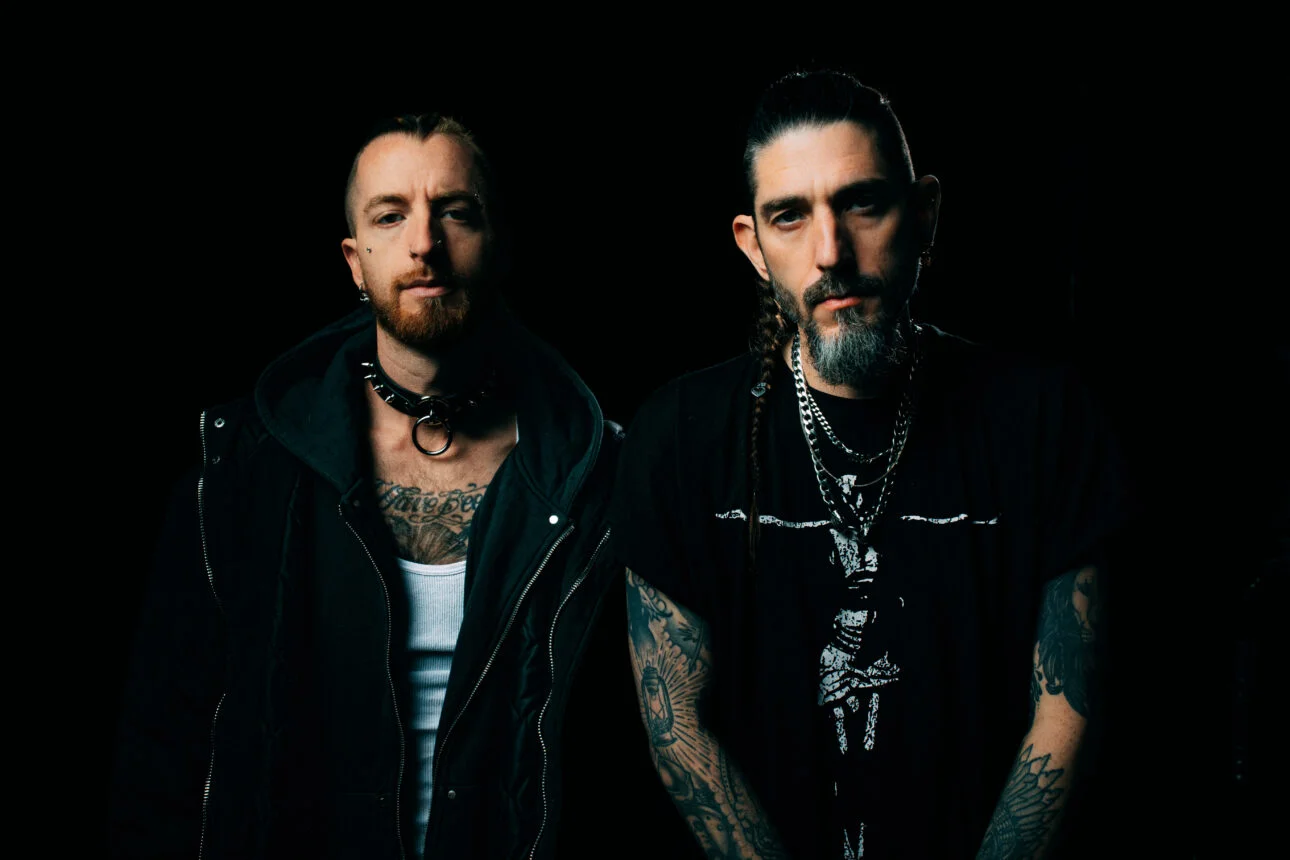
Missio, an alternative electronic duo out of Austin, Texas, composed of Matthew Brue on vocals and David Butler behind the boards, released their sixth record, Love & Heartbreak, on July 3rd through Nettwerk. Sonically, it’s a conscious return to minimal electronic production, guitars are largely retired and dark synths carry the tracks. Lyrically, it’s their first about love.
SPIN spoke with Brue and Butler about the inspiration behind it all, the highs and lows of finding wholeness in heartbreak, and opening your mind to new horizons.
More from Spin:
- Kacey Musgraves Gets Steamy In NSFW ‘Mexico Honey’ Video
- More Neil Young Covers On The Way As Tribute Series Expands
- Protomartyr Returns With Scathing New Single, LP
“We haven’t written about love very much,” Brue says. Building a career, touring, and a general tendency towards solitude, haven’t left much room for dating or romance. And yet, love found him when he least expected it, when Brue entered a relationship that cracked him open with both beauty and heartbreak, and this album was built from inside of that.
Although the relationship didn’t last, and promoting a record built from it means reliving the breakup in interview after interview, which he admits he hates, it’s part of the creative journey. The love he’s talking about extends beyond the romantic. It pulses through friendship, and the creative act itself.
Brue and Butler have made music together as Missio for ten years, both having come up in earlier groups where egos clashed and competitiveness eclipsed collaborative energies. What they have now runs on brutal honesty, an artistic synthesis where two people relinquish their egos, stay honest instead of passive, and keep asking what’s best for each other and for the song. “If it’s your idea, we’re gonna celebrate that,” Brue says. “If it’s my idea, we’re gonna celebrate that.”
They didn’t even make Love & Heartbreak in the same room. Butler worked from Austin, and Brue moved through a series of Airbnbs, including one in Mexico City, a city long shadowed by the meaning-seeking creatives and expats who went there to work, and find inspiration. Among them was William S. Burroughs, the Beat Generation icon who wrote Junkie, his unrepentant novel about heroin addiction, in a gloomy apartment in the Roma Norte. While their sessions went back and forth across multiple time zones, the distance freed both of them in ways they didn’t anticipate.
In a shared studio, Butler defaults to engineer and producer, running the session and pulling up sounds. Alone, he could choose his own pace. “Working by myself allows me to work slower,” he says, “so I have more time to kind of put myself into whatever I’m doing.” Brue wanted that time for a different reason. In a booked studio you have three weeks to finish fifteen songs, and there are days when the take you want simply isn’t in you. “Sometimes the best vocals come at 2AM, when you’re feeling a very specific kind of way,” he says. Alone, he could wait for the muse to strike, and re-sing a part as many times as he needed, no one watching, free to belt it out, no holds barred at four in the morning if that was when it decided to arrive.
The Songs
Butler’s favorite song in this new release is “Dreams,” the opening track, a song that broke him into tears the first time he listened to it. For Butler, who has been happily married for years, the expansiveness of love includes making music and creating art. Making something out of nothing is the reason he got into this at all, and music has been one of the great loves of his life. “Dreams” reminded him that his oldest love is music itself. “I love when music does this,” he says. “When you write the song, and you understand it, and then you come back to it, and you’re like, oh my god, I didn’t even understand what we were doing…This album and this moment in my life is ‘Dreams.’ And in ‘Dreams,’ my love is music. It can break my heart, it can be the hardest thing in the world.”
Brue’s pick is “The Moment,” the closer, which he thinks may be his favorite thing the band has ever made. “It feels like such a perfect depiction of loving somebody, encapsulated into a song.” His other is “Superpower,” a song about opening your mind, written by a man raised in a religion where that was considered dangerous. “Now more than ever, there’s a lot of people who are closed-minded about politics, or about the way that people exist in the world, and it has to be their way, otherwise it’s just wrong,” he says. “There’s so much nuance and complexity to the world.” Every time he’s opened his mind against his own instincts, he says, he’s landed somewhere happier.
Butler credits the band’s touring life for the same shift. They’ve played Europe, Mexico, Canada, China, and Russia and Ukraine before the war, journeys that have helped them grow and evolve; “leveling up,” in their own words. People in their circle would warn them a place was unsafe, and then they’d arrive and stand eye to eye with people the world seems to want them not to get along with. Fans in China tell them the same thing fans in the States do, which is that the music got them through a dark time. “You just start to be like, maybe I don’t know everything,” Butler says, “and that’s a better place to start approaching it.”
When I bring up “Self-Deprecation,” a track as brutal as it is beautiful, the kind of song that names that ugly, pernicious, intrusive thought and self-limiting belief that so many of us struggle with, but are often afraid to share out loud. Thinking about it for a moment, Brue confesses that he often hears a lot of songs that don’t give him the honesty he’s looking for. “When you do hear a brutal lyric like ‘Self-Deprecation,’ even those two words, it kind of makes you lean back,” he says. “That is what people are looking for, because they feel that way.” He’d rather be an open book, he says, if it helps people truly process their shit, rather than steer toward a more peaceful terminology. “Sometimes it’s better to be more aggressive.”
Hopes
When I ask the duo what it is that they want out of the record, Butler shares that he wants people to feel seen. He is talking specifically to the listener who believes the world is a terrible place and that it’s uniquely terrible to them. He wants that person to find their own story in these songs and create some hope out of it.
Brue wants something more immediate. “Frankly, escapism,” he says. “Just allow them to escape the realities that can be really fucking brutal right now.” He’s chasing a fleeting feeling he’s had maybe a handful of times as a listener, “when a song arrives and you play it a thousand times because it’s doing work you can’t do yourself”. He worries infinite choice has cost people the ability to cherish anything, but he holds onto a hope for this album too. If you’re newly in love, he hopes it helps you fall deeper. And if you’re in heartbreak, he hopes it helps you process, and move forward to what’s next.
That instinct to immediately move toward what’s next runs up against a future no one can quite see, one increasingly shaped by algorithms, artificial intelligence, and the uncanny. The industry is shifting, but Brue’s answer isn’t to move faster; it’s to refuse to do so. “I’m not looking to be more efficient,” he says. He’ll spend three days on a single arrangement, turning over what works and what doesn’t, and by the time a song is finished he’s usually already left it, because the making was always the point. “I want to take my time and really enjoy the energy and the feelings that come with it.” Everything they built this album from, the honesty, the heartbreak, the friendship, is in that too. Making something slowly, and with love, because love is the point.
Healing Out Loud
Missio offers a unique permission to be authentic. To know that it is OK to heal out loud, to be vulnerable, to be honest. To yearn and feel and breathe, to create and sing your way through it, through addiction and sobriety, through the low valleys and the climbs back out, the whole spectrum of being human from cradle to grave, darkness to light. Moments that help their fans find solidarity in the journey, and moments that have rippled out into the culture at large.
For instance, their songs have found their way into pop culture, from “KING,” an original track written for Fortnite, to “Bottom of the Deep Blue Sea” on 13 Reasons Why. So I ask what film these new ones belong to. To his own surprise, Brue says he’d rather not be in a blockbuster. He’d want something like Eternal Sunshine of the Spotless Mind. Poetic, under the radar, the kind of film you discover rather than get sold. “And then when you discover it, it becomes everything for you.”
It’s a fitting selection for a record like this one. In Eternal Sunshine, a man pays to have a heartbreak erased and finds his way back to the same woman anyway, love outrunning the attempt to forget it. Love & Heartbreak circles a similar theme. If a broken heart is possible, maybe even inevitable, will the fear of it keep you from experiencing the magnificence of all that love holds? Across all fourteen songs, Missio never answers definitively. The romance of the record lives within the question itself.
Their US tour begins in fall 2026, and Love & Heartbreak is out now on Nettwerk.
To see our running list of the top 100 greatest rock stars of all time, click here.